Question Library
Browse, filter, and study verified past examination questions with step-by-step mathematical reasoning.
Searching 18,000+ Questions...
Sifting topics, KaTeX formulas & verified solutions
Showing 151–165 of 5315 verified questions
Sort by:
Physics
UTME / JAMB 2025
Refraction of Light
Solution
I. The colour of light depends on its frequency II. When white light is dispersed by a triangular prism, yellow is deviated more than green III. Rainbows are formed when rains fall heavily. Which of the above statements is/are correct about dispersion and colours?
A
I and III only
B
I only
C
II and III only
D
I and II only
medium Difficulty
Verified Correct Answer: Option B
Physical Principles & Numerical Solution
Answer: B. I only (I true; II false, yellow deviated less than green; III false, rainbows from light refraction in drops.)
Source: WAEC / JAMB / NECO Classroom Archive (Record #74359)
Physics
UTME / JAMB 2025
Refraction of Light
Solution
If the critical angle for a glass–air boundary is 45º, what is the refractive index of the glass?
A
\(\sqrt{2}\)
B
\(\sqrt{5}\)
C
\(\sqrt{3}\)
D
2\(\sqrt{2}\)
medium Difficulty
Verified Correct Answer: Option A
Physical Principles & Numerical Solution
Answer: A
n = \(\frac{1}{\text{sinC}}\) = \(\frac{1}{sin45º}\) = \(\sqrt{2}\).
Source: WAEC / JAMB / NECO Classroom Archive (Record #74371)
Physics
UTME / JAMB 2025
Refraction of Light
Diagram
Solution
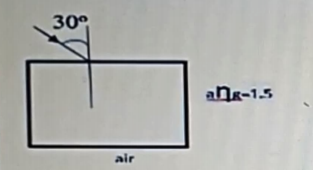
From the diagram above, the sine of the angle of refraction in glass is
Attached Figure / Diagram
A
0.4
B
0.3
C
0.2
D
0.1
medium Difficulty
Verified Correct Answer: Option B
Physical Principles & Numerical Solution
\(_ag_g\) = \(\frac{\text{sini}}{\text{sinr}}\)
sinr = \(\frac{\text{sini}}{_ag_g}\)
sinr = \(\frac{0.5}{1.5}\)
sinr = 0.3
Source: WAEC / JAMB / NECO Classroom Archive (Record #74493)
Physics
UTME / JAMB 2025
Refraction of Light
Solution
What colour has the lowest frequency in the spectrum of white light?
A
Red
B
Yellow
C
Indigo
D
Blue
medium Difficulty
Verified Correct Answer: Option A
Physical Principles & Numerical Solution
A. Red
Red light has the longest wavelength and the lowest frequency compared to the other colors listed.
ROYGBIV: arranged in increasing frequency or decreasing wavelength.
Source: WAEC / JAMB / NECO Classroom Archive (Record #74563)
Physics
UTME / JAMB 2025
Refraction of Light
Diagram
Solution
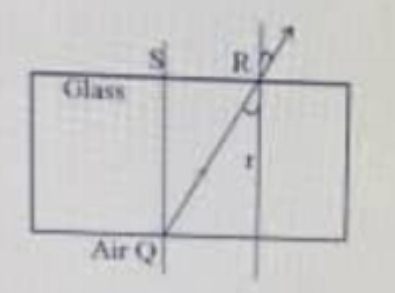
Given that SQ = 10cm and SR = 6cm, the refractive index of the block of glass shown in the above figure is
Attached Figure / Diagram
A
1.67
B
0.60
C
0.30
D
2.33
medium Difficulty
Verified Correct Answer: Option A
Physical Principles & Numerical Solution
For a ray entering and exiting parallel faces of a glass slab, the refractive index is given by:
n = \(\frac{\text{real depth}}{\text{apparent depth}}\)
Where SR = 6cm is apparent depth, SQ = 10cm real depth.
n = \(\frac{10}{6}\) = 1.6666 ≈ 1.67
Source: WAEC / JAMB / NECO Classroom Archive (Record #74660)
Physics
WAEC / WASSCE 2025
Refraction of Light
Diagram
Solution
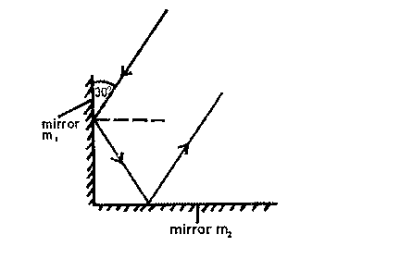
A ray of light is incident on mirror m\(_1\) and after reflection is incident on mirror m\(_2\) as shown in the diagram above. Calculate the angle of reflection of the ray at mirror m\(_2\).
Attached Figure / Diagram
A
60\(^0\)
B
90\(^0\)
C
30\(^0\)
D
120\(^0\)
medium Difficulty
Verified Correct Answer: Option C
Physical Principles & Numerical Solution
i at m\(_1\) = 60^\circ → r = 60^\circ at m\(_1\) (law of reflection i ^\circ = r ^\circ) i at m\(_2\) = 30^\circ
i = r,
∴ r = 30^\circ
Source: WAEC / JAMB / NECO Classroom Archive (Record #76365)
Physics
WAEC / WASSCE 2025
Refraction of Light
Diagram
Solution
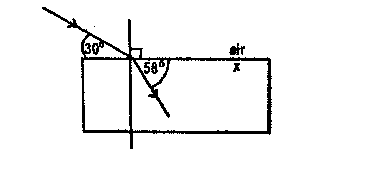
A ray of light is incident on a body x as shown in the diagram above. What is the refractive index of the body?
Attached Figure / Diagram
A
1.33
B
1.63
C
1.50
D
1.49
medium Difficulty
Verified Correct Answer: Option B
Physical Principles & Numerical Solution
\(\lambda\) = \(\frac{\text{Sin i}}{\text{Sin r}}\) = \(\frac{Sin 60º}{Sin 32º}\) = 1.63
Source: WAEC / JAMB / NECO Classroom Archive (Record #76366)
Physics
WAEC / WASSCE 2025
Refraction of Light
Solution
The image of any real object formed by a diverging lens is always
A
magnified
B
inverted
C
erect
D
real
medium Difficulty
Verified Correct Answer: Option C
Physical Principles & Numerical Solution
For all positions of the object formed by a concave (diverging) lens, the image is virtual, erect, and diminished.
Source: WAEC / JAMB / NECO Classroom Archive (Record #76368)
Physics
WAEC / WASSCE 2025
Refraction of Light
Diagram
Solution
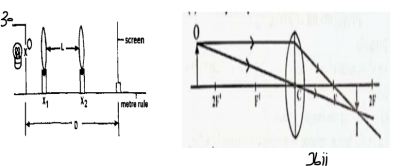
2a.
(i) Fix a metre rule on the bench with the graduated face up.
(ii) Place the illuminated object at the zero end of the rule and the screen at the other end as illustrated in the diagram above.
(iii) Measure and record D, the distance between the object and the screen. Evaluate D\(^2\)
(iv) Place and move the converging lens between the illuminated object and the screen until a diminished, sharp image of the object is formed on the screen. Read and record the position, x\(_1\), of the lens. From this position, move the lens towards the object until another sharp image of the object is formed on the screen. Read and record the position, x\(_2\), of the lens.
(v) Evaluate and record L = (x\(_1\) - x\(_2\)), L\(^2\) and (D\(^2\) - L\(^2\)).
(vi) Repeat the procedure for D = 90, 80, 70, and 60 cm. In each case, evaluate L, L\(^2\), and (D\(^2\) - L\(^2\)). Tabulate your readings.
(vii) Plot a graph of D\(^2\) - L\(^2\) on the vertical axis against D on the horizontal axis.
(viii) Determine the slope, s, of the graph and evaluate K = \(\frac{\text{s}}{4}\). State two precautions taken to ensure accurate results.[21 marks]
bi. Distinction Between Real and Virtual Images [2 marks]
ii. Draw a ray diagram to show how a converging lens may be used to form a real diminished image of an object [2 marks]
Attached Figure / Diagram
medium Difficulty
Verified Correct Answer: Option
Physical Principles & Numerical Solution
2a. Table of observations
D(cm)
D\(^2\)(cm\^2\)
X\(_1\)(cm)
L = (X\(_1 - X_2\))
L\(^2\)(cm\(^2\))
100
10000
80.50
62.20
3868.8
90
8100
70.20
51.20
2621.4
80
6400
59.10
39.10
1528.8
70
4900
46.70
24.70
610.09
60
3600
29.00
21.40
457.96
S = \(\frac{y_2 - y_1}{x_2 - x_1}\) = \(\frac{6250 - 3250}{100 - 60}\) = \(\frac{3000}{40}\) = 75
K = \(\frac{\text{s}}{4}\) = \(\frac{75}{4}\) = 18.75
Precautions:
(i) I carefully avoided parallax error by ensuring my eyes were directly in line with the markings on the metre rule while taking measurements to improve accuracy.
(ii) I adjusted the setup and focused precisely to ensure a sharp and well-defined image was formed on the screen, minimizing errors due to blurriness or misalignment.
(iii) I made sure that the experimental apparatus was stable and free from vibrations to avoid any disturbance during measurements.
(iv) I ensured that the metre rule was properly calibrated and positioned perpendicular to the setup to prevent measurement inaccuracies due to angle errors.
bi. A real image is formed when light rays converge and meet at a point, allowing it to be projected onto a screen. It is typically inverted relative to the object, as seen in concave mirrors or convex lenses when the object is beyond the focal point.
On the other hand, a virtual image is formed when light rays appear to diverge from a point but do not actually meet. This type of image cannot be projected onto a screen and is always upright, as seen in plane mirrors or convex mirrors.
bii. See diagram above.
Source: WAEC / JAMB / NECO Classroom Archive (Record #76580)
Physics
UTME / JAMB 2025
Waves
Solution
The distance between two successive trough points of a wave is
A
two wavelength
B
a wavelength
C
one third wavelength
D
half wavelength
medium Difficulty
Verified Correct Answer: Option B
Physical Principles & Numerical Solution
The distance between two successive troughs of a wave is equal to one wavelength (\lambda)
One wavelength (\lambda) is defined as the distance between two successive points in the same phase (crest to crest or trough to trough).
Source: WAEC / JAMB / NECO Classroom Archive (Record #74562)
Physics
WAEC / WASSCE 2025
Waves
Solution
Sixty complete waves pass a particular point in 4s. If the distance between three successive troughs of the waves is 15 m, calculate the speed of the waves.
A
75.0 ms\(^{-1}\)
B
225.0 ms\(^{-1}\)
C
300.0 ms\(^{-1}\)
D
112.5 ms\(^{-1}\)
medium Difficulty
Verified Correct Answer: Option D
Physical Principles & Numerical Solution
f = \(\frac{\text{no of oscillation made}}{t(s)}\) = \(\frac{60}{4}\) = 15 Hz
This distance equals 2 wavelengths (because there are 3 troughs, each with 2 intervals between them).
2\(\lambda\) = 15
\(\lambda\) = \(\frac{15}{2}\) = 7.5m
V = f\(\lambda\)
v = 15 \times 7.5 = 112.5 ms\(^{-1}\)
Source: WAEC / JAMB / NECO Classroom Archive (Record #76374)
Physics
WAEC / WASSCE 2025
Waves
Solution
Which of the following wave characteristics can be used to distinguish a transverse wave from a longitudinal wave?
A
Diffraction
B
Polarisation
C
Refraction
D
Reflection
medium Difficulty
Verified Correct Answer: Option B
Physical Principles & Numerical Solution
Polarisation only occurs with a wave whose direction is perpendicular to its vibration (i.e., transverse waves)
Source: WAEC / JAMB / NECO Classroom Archive (Record #76377)
Physics
WAEC / WASSCE 2025
Waves
Solution
The period of a wave is 0.02 seconds. Calculate its wavelength if its speed is 330 ms\(^{-1}\)
A
3.3 m
B
4.0 m
C
6.6 m
D
5.0 m
medium Difficulty
Verified Correct Answer: Option C
Physical Principles & Numerical Solution
T = 0.02 s; \lambda = ?; v = 330 ms⁻¹;
f = \(\frac{1}{\text{T}}\) = \(\frac{1}{0.02}\) = 50 Hz
But; v = f\lambda
\lambda = \(\frac{\text{v}}{\text{f}}\) = \(\frac{330}{50}\) = 6.6 m
Source: WAEC / JAMB / NECO Classroom Archive (Record #76381)
Physics
UTME / JAMB 2025
Sound Wave
Solution
What happens to the speed of sound in air when the pressure increases at a constant temperature
A
Unchanged
B
Increase
C
Reduce
D
Varies
medium Difficulty
Verified Correct Answer: Option A
Physical Principles & Numerical Solution
The speed of sound in air at a constant temperature is primarily dependent on the temperature of the air rather than the pressure. At a constant temperature, changes in pressure do not significantly affect the speed of sound.
Source: WAEC / JAMB / NECO Classroom Archive (Record #74494)
Physics
UTME / JAMB 2025
Sound Wave
Solution
The speed of sound in air is 60 m/s. How far from the centre of a storm is an observer who hears a thunder clap 4s after the flash of the lightning?
A
140m
B
100m
C
340m
D
240m
medium Difficulty
Verified Correct Answer: Option D
Physical Principles & Numerical Solution
Speed of sound = 60 m/s
Time delay = 4 s (light travel time is negligible)
Distance = speed \times time = 60 \times 4 = 240 m
Source: WAEC / JAMB / NECO Classroom Archive (Record #74545)