Question Library
Browse, filter, and study verified past examination questions with step-by-step mathematical reasoning.
Searching 18,000+ Questions...
Sifting topics, KaTeX formulas & verified solutions
Showing 151–165 of 345 verified questions
Sort by:
Mathematics
UTME / JAMB 2005
Statistics and Probability
Solution
What is the probability that an integer x,(1 \(\leq\) x \(\leq\) 20) chosen at random is divisible by both 2 and 3?
A
\(\frac{1}{20}\)
B
\(\frac{1}{3}\)
C
\(\frac{3}{20}\)
D
\(\frac{7}{10}\)
medium Difficulty
Verified Correct Answer: Option C
Step-by-Step Mathematical Solution
U = {1,2,3,4,5,6,7,8,9,10,11,12,13,14,15,16,17,18,19,20}
A = {x/x is divisible by 2}
A = {2,4,6,8,10,12,14,16,18,20}
B = {x/x is divisible by 3}
A ∩ B = {6, 12, 18}
P(Number divisible by both 2 and 3)
= 3/20
Source: Myschool Past Questions Archive (Record #8615)
Mathematics
WAEC / WASSCE 2005
Statistics and Probability
Solution
A fair die is tossed once, what is the probability of obtaining neither 5 or 2
A
\(\frac{5}{6}\)
B
\(\frac{2}{3}\)
C
\(\frac{1}{2}\)
D
\(\frac{1}{6}\)
medium Difficulty
Verified Correct Answer: Option B
Step-by-Step Mathematical Solution
Probability of obtaining a 5 is P(5)=\(\frac{1}{6}\)
Probability of obtaining a 2 is P(2)=\(\frac{1}{6}\)
Probability of obatining either 2 or 5 = P(2∪5) = \(\frac{2}{6}\)
Probability of obtaining neither 5 or 2 = \(1 - \frac{2}{6}=\frac{4}{6}=\frac{2}{3}\)
Source: Myschool Past Questions Archive (Record #26677)
Mathematics
WAEC / WASSCE 2005
Statistics and Probability
Solution
The probability that John and James pass an examination are 3/4 and 3/5 respectively, find the probability of both boys failing the examination
A
\(\frac{1}{10}\)
B
\(\frac{3}{10}\)
C
\(\frac{9}{20}\)
D
\(\frac{11}{20}\)
medium Difficulty
Verified Correct Answer: Option A
Step-by-Step Mathematical Solution
Prob.(John pass)\(=frac{3}{4}\) prob.(John fail) \(=1-frac{3}{4}=\frac{1}{4}\)
Prob.(James pass) \(=frac{3}{5}\) Prob.(James fail) \(=1-frac{3}{5}=\frac{2}{5}\)
Prob(both boys fail)\(=frac{1}{4}\times \frac{2}{5}=\frac{1}{10}\)
Source: Myschool Past Questions Archive (Record #26685)
Mathematics
WAEC / WASSCE 2005
Statistics and Probability
Solution
Find the mean of the numbers 1, 3, 4, 8, 8, 4 and 7
A
4
B
5
C
6
D
7
medium Difficulty
Verified Correct Answer: Option B
Step-by-Step Mathematical Solution
mean \(=\frac{1+3+4+8+8+4+7}{7}=\frac{35}{7}=5\)
Source: Myschool Past Questions Archive (Record #26695)
Mathematics
NECO SSCE 2005
Statistics and Probability
Find the absolute mean deviation of the sample 10, 12, 14, 11, 13.
A
14.6
B
14
C
12
D
6.2
E
1.2
medium Difficulty
Verified Correct Answer: Option E
Step-by-Step Mathematical Solution
No expanded working has been attached for this question yet. The verified answer is Option E.
Source: Myschool Past Questions Archive (Record #42362)
Mathematics
NECO SSCE 2005
Statistics and Probability
A bag contains 4 blue and 8 red identical balls. If two balls are picked at random with replacement, what is the probability of picking two balls of different colours?
A
1
B
\(\frac{13}{26}\)
C
\(\frac{5}{18}\)
D
\(\frac{4}{9}\)
E
\(\frac{2}{9}\)
medium Difficulty
Verified Correct Answer: Option D
Step-by-Step Mathematical Solution
No expanded working has been attached for this question yet. The verified answer is Option D.
Source: Myschool Past Questions Archive (Record #42378)
Mathematics
NECO SSCE 2005
Statistics and Probability
Two fair dice are tossed together once. What is the probability of getting a total of at least 9 from the outcome?
A
\(\frac{1}{9}\)
B
\(\frac{1}{6}\)
C
\(\frac{5}{18}\)
D
\(\frac{1}{3}\)
E
\(\frac{13}{18}\)
medium Difficulty
Verified Correct Answer: Option C
Step-by-Step Mathematical Solution
No expanded working has been attached for this question yet. The verified answer is Option C.
Source: Myschool Past Questions Archive (Record #42465)
Mathematics
WAEC / WASSCE 2005
Statistics and Probability
Solution
The table shows the age distributions of the members of a club.
Age (years)
10-14
15-19
20-24
25-29
30-34
35-39
Frequency
7
18
25
17
9
4
(a) Calculate, correct to one decimal place, the mean age.
(b) (i) Draw a histogram to illustrate the information.
(ii) Use the histogram to estimate the modal age .
(c) If a member is selected at random, what is the probability that he/she is in the modal class?
medium Difficulty
Verified Correct Answer: Option
Step-by-Step Mathematical Solution
(a)
Class Interval
Freq (f)
Classmark (x)
\(fx\)
10 - 14
7
12
84
15 - 19
18
17
306
20 - 24
25
22
550
25 - 29
17
27
459
30 - 34
9
32
288
35 - 39
4
37
148
80
1835
\(\bar{x} = \frac{\sum fx}{\sum f}\)
= \(\frac{1835}{80}\)
\(\approxeq 22.9yrs\)
(b)(i)
Class Interval
Freq (f)
Class boundaries
10 - 14
7
9.5 - 14.5
15 - 19
18
14.5 - 19.5
20 - 24
25
19.5 - 24.5
25 - 29
17
24.5 - 29.5
30 - 34
9
29.5 - 34.5
35 - 39
4
34.5 - 39.5
(ii) Modal age = \(\frac{20 + 24}{2} = 22\)
(c) P(picking from the modal class) = \(\frac{25}{80}\)
= \(\frac{5}{16}\).
Source: Myschool Past Questions Archive (Record #53118)
Mathematics
UTME / JAMB 2004
Statistics and Probability
Solution
Some white balls put in a basket containing twelve red balls and sixteen black balls. If the probability of picking a white ball from the baskets is \(\frac{3}{7}\), how many white balls were introduced?
A
12
B
21
C
28
D
32
medium Difficulty
Verified Correct Answer: Option B
Step-by-Step Mathematical Solution
Number of white balls = x
Number of red balls = 12
Number of black balls = 16
Total number of balls = 28 + x
P(white balls) = 3/7
But P(white balls) \(= \frac{x}{28+x}\)
= \(\frac{3}{7} = \frac{x}{28+x}\)
3(28 + x) = 7x
84 + 3x = 7x
7x - 3x = 84
4x = 84
x = 21
Source: Myschool Past Questions Archive (Record #8189)
Mathematics
UTME / JAMB 2004
Statistics and Probability
Solution
find the mean deviation of 1, 2, 3 and 4
A
2.5
B
2.0
C
1.0
D
1.5
medium Difficulty
Verified Correct Answer: Option C
Step-by-Step Mathematical Solution
X = 1, 2, 3, 4; ∑X = 10
x = ∑X/n = 10/4 = 2.5
X - x = -1.5, -0.5, 0.5, 1.5
lX - xl = 1.5, 0.5, 0.5, 1.5; ∑lX - xl = 4.0
mean deviation = (∑lX - xl)/n
= 4.0/4
= 1.0
Source: Myschool Past Questions Archive (Record #8190)
Mathematics
UTME / JAMB 2004
Statistics and Probability
Diagram
Solution
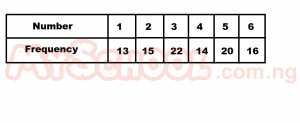
An unbiased die is rolled 100 times and the outcome is tabulated above.
What is the probability of obtaining a 5?
Attached Figure / Diagram
A
1/5
B
1/2
C
1/6
D
1/4
medium Difficulty
Verified Correct Answer: Option A
Step-by-Step Mathematical Solution
Number of times 5 was obtained = 20
P(obtaining 5) = 20/100
= 1/5
Source: Myschool Past Questions Archive (Record #8191)
Mathematics
UTME / JAMB 2004
Statistics and Probability
Solution
The mean age of a group of students is 15 years. When the age of a teacher, 45 years old, is added to the age of the students, the mean of their ages becomes 18 years. Find the number of the students in the group
A
9
B
7
C
42
D
15
medium Difficulty
Verified Correct Answer: Option A
Step-by-Step Mathematical Solution
Let the number of students = x
Total age of the students = 15x
Total age including age of the teacher = 15x + 45
Mean of their ages; (15x + 45)/(x + 1) = 18
15x + 45 = 18(x + 1)
15x + 45 = 18x + 18
18x - 15x = 45 - 18
3x = 27
x = 9
Source: Myschool Past Questions Archive (Record #8194)
Mathematics
UTME / JAMB 2004
Statistics and Probability
Solution
A container has 30 gold medals, 22 silver medals and 18 bronze medals. If one medals is selected at the random from the container, what is the probability that it is not a gold medal?
A
9/35
B
11/35
C
4/7
D
3/7
medium Difficulty
Verified Correct Answer: Option C
Step-by-Step Mathematical Solution
Gold medals = 30
silver medals = 22
Bronze medals = 18/70
P(Gold medals) = 30/70 = 3/7
∴ P(not Gold medal) = 1 - 3/7
= 4/7
Source: Myschool Past Questions Archive (Record #8195)
Mathematics
WAEC / WASSCE 2004
Statistics and Probability
Solution
There are m boys and 12 girls in a class. What is the probability of selecting at random a girl from the class?
A
\(\frac{m}{12}\)
B
\(\frac{12}{m}\)
C
\(\frac{12}{m+12}\)
D
\(\frac{12}{m-12}\)
medium Difficulty
Verified Correct Answer: Option C
Step-by-Step Mathematical Solution
- Number of favourable outcomes = number of girls = 12
- Total number of possible outcomes = total students = m boys + 12 girls = m + 12
Therefore,
Probability of selecting a girl = \(\dfrac{\text{Number of girls}}{\text{Total number of students}} = \dfrac{12}{m + 12}\).
Source: Myschool Past Questions Archive (Record #26624)
Mathematics
WAEC / WASSCE 2004
Statistics and Probability
Solution
Find, correct to two decimal places, the mean of 9, 13, 16, 17, 19, 23, 24.
A
23.00
B
17.29
C
16.50
D
16.33
medium Difficulty
Verified Correct Answer: Option B
Step-by-Step Mathematical Solution
Mean \(= \frac{sum\hspace{1mm}of\hspace{1mm}all\hspace{1mm}the\hspace{1mm}numbers}{Total\hspace{1mm}Number}\\
\frac{9+13+16+17+19+23+24}{7}\\
\frac{121}{7}=17.2857=17.29\)
Source: Myschool Past Questions Archive (Record #26639)