Question Library
Browse, filter, and study verified past examination questions with step-by-step mathematical reasoning.
Searching 18,000+ Questions...
Sifting topics, KaTeX formulas & verified solutions
Showing 136–150 of 784 verified questions
Sort by:
Physics
UTME / JAMB 2015
Waves and Optics
Solution
When a man moves toward a plane mirror at a speed of 6m/s, the distance the man and his image increased at a speed of?
A
2 m/s
B
4 m/s
C
12 m/s
D
14 m/s
medium Difficulty
Verified Correct Answer: Option C
Physical Principles & Numerical Solution
Given: Speed of the man (v) = 6 m/s
Distance Calculation:
Distance to the Mirror: As the man moves toward the mirror, the distance between him and the mirror decreases by 6 m/s.
Distance to the Image: The image moves toward the man at the same speed (6 m/s).
Total Change in Distance:
The total distance between the man and his image decreases at the rate of:
Rate of distance change = v + v = 6 m/s + 6 m/s = 12 m/s
Conclusion: The distance between the man and his image increases at a speed of 12 meters per second.
Source: Myschool Past Questions Archive (Record #41329)
Physics
UTME / JAMB 2015
Waves and Optics
Solution
An alternating current with a frequency of 100HZ has a period of
A
0.03sec
B
0.01sec
C
0.04sec
D
0.15sec
medium Difficulty
Verified Correct Answer: Option B
Physical Principles & Numerical Solution
F = 100HZ, period, T = 1/f = 1/100
= 0.01 sec
The period (T) = 0.01sec
Source: Myschool Past Questions Archive (Record #41340)
Physics
WAEC / WASSCE 2015
Waves and Optics
What type of wave is emitted by a loud speaker?
A
Transverse
B
Longitudinal
C
Gamma
D
Radio
medium Difficulty
Verified Correct Answer: Option B
Physical Principles & Numerical Solution
No expanded working has been attached for this question yet. The verified answer is Option B.
Source: Myschool Past Questions Archive (Record #45467)
Physics
WAEC / WASSCE 2015
Waves and Optics
Solution
An object is placed 15cm from a diverging lens of focal length 12cm. The image of the object formed by the lens in
A
real and 6.67cm from the lens
B
virtual and 6.67cm from the lens
C
real and 60.00cm from the lens
D
virtual and 60.00cm from the lens
medium Difficulty
Verified Correct Answer: Option B
Physical Principles & Numerical Solution
The focal length of a diverging lens is negative.
f = -12 cm; u = 15 cm.
\(f = \frac{uv}{u + v}\)
\(-12 = \frac{15v}{15 + v}\)
\(-12 (15 + v) = 15v \implies -180 - 12v = 15v\)
\(-180 = 15v + 12v \implies -180 = 27v\)
\(v = \frac{-180}{27} = -6.67 cm\)
The image is virtual and 6.67 cm from the lens.
Source: Myschool Past Questions Archive (Record #45468)
Physics
WAEC / WASSCE 2015
Waves and Optics
When an air column is set into vibrations, the distance between two consecutive nodes of the resultant wave is
A
one quarter of the wavelength
B
half of the wavelength
C
the wavelength
D
twice the wavelength
medium Difficulty
Verified Correct Answer: Option B
Physical Principles & Numerical Solution
No expanded working has been attached for this question yet. The verified answer is Option B.
Source: Myschool Past Questions Archive (Record #45489)
Physics
WAEC / WASSCE 2015
Waves and Optics
Solution
A girl standing some distance from the cliff claps her hands and hears the echo 0.8s later. calculate her distance from the cliff. [speed of sound in air = 320 ms-1]
A
23m
B
128m
C
288m
D
298m
medium Difficulty
Verified Correct Answer: Option B
Physical Principles & Numerical Solution
V = \(\frac{2nx}{E}\)
= \(\frac{2 \times 1 \times X}{0.8} = 320\)
2x = 0.8 x 320
x = \(\frac{0.8 \times 320}{2}\)
= 128m
Source: Myschool Past Questions Archive (Record #45503)
Physics
WAEC / WASSCE 2015
Waves and Optics
Diagram
Solution
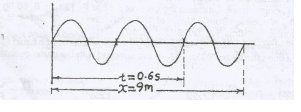
The diagram given illustrates a wave form. Determine the speed of the wave
Attached Figure / Diagram
A
5.4 ms-1
B
8.4 ms-1
C
9.6 ms-1
D
10.0 ms-1
medium Difficulty
Verified Correct Answer: Option D
Physical Principles & Numerical Solution
The diagram illustrates three complete cycles over a distance of 9 m. Therefore, the wavelength \lambda is 9 m / 3 = 3 m.
The time t = 0.6 s corresponds to two periods (based on the labeling in the diagram spanning two cycles). Therefore, the period T is \(\frac{0.6 s }{2}\) = 0.3 s.
The speed of the wave v is given by v = \(\frac{\lambda }{\text{T}}\) = \(\frac{3 m }{0.3 s}\) = 10 m/s.
Source: Myschool Past Questions Archive (Record #45466)
Physics
WAEC / WASSCE 2015
Waves and Optics
Red light travels faster than blue light when both of them pass through a glass prism because the
A
refractive index of red light is grester than that of blue light
B
refractive index of blue light is greater than that of red light
C
red light is more intense than the blue light
D
blue light is more intense than the red light
medium Difficulty
Verified Correct Answer: Option D
Physical Principles & Numerical Solution
No expanded working has been attached for this question yet. The verified answer is Option D.
Source: Myschool Past Questions Archive (Record #45516)
Physics
WAEC / WASSCE 2015
Waves and Optics
Solution
An object is placed 20cm from a concave mirror of focal length 15cm. Calculate the linear magnification of the image formed
A
0.5
B
1.5
C
2.0
D
3.0
medium Difficulty
Verified Correct Answer: Option D
Physical Principles & Numerical Solution
\(\frac{1}{U} + \frac{1}{V} = \frac{1}{F}\)
\(\frac{1}{V} = \frac{1}{F} - \frac{1}{U}\)
\(\frac{1}{V} = \frac{1}{15} - \frac{1}{20}\)
\(\frac{1}{V} = \frac{\text{4 - 3}}{60}\)
\(\frac{1}{V} = \frac{1}{60}\)
V = 60cm
M = \(\frac{V}{U} = \frac{60}{20}\)
M = 3.0cm
Source: Myschool Past Questions Archive (Record #45523)
Physics
WAEC / WASSCE 2015
Waves and Optics
All electromagnetic waves in a vacuum have the same
A
wavelength
B
frequency
C
speed
D
amplitude
medium Difficulty
Verified Correct Answer: Option C
Physical Principles & Numerical Solution
No expanded working has been attached for this question yet. The verified answer is Option C.
Source: Myschool Past Questions Archive (Record #45526)
Physics
WAEC / WASSCE 2015
Waves and Optics
Solution
An alternating current supply is connected to an electric lamp which lights with the same brightness as it does with direct current source emf 6v. The peak potential difference of the a.c supply is
A
4.6v
B
6.0v
C
8.5v
D
12.0v
medium Difficulty
Verified Correct Answer: Option C
Physical Principles & Numerical Solution
Vo = V\(\_{rms}\) x \(\sqrt{2}\)
Vo = 6 x 1.414
Vo = 8.484
= 8.5v
Source: Myschool Past Questions Archive (Record #45536)
Physics
WAEC / WASSCE 2015
Waves and Optics
Diagram
Solution
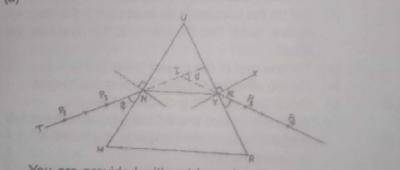
You are provided with a triangular glass prism, four optical pins, and other necessary materials.
Place the triangular glass prism on a drawing paper and draw its outline UMR. Remove the prism.
Measure and record the value of the angle at U.
Draw a normal to the line UM at N. Also, draw another line TN to the normal such that \(\phi\)-60. Fix two pins at \(P_1\) and \(P_2\).
Replace the prism and fix two other pains at \(P_3\), and \(P_4\), such that the pins appear to be in a straight line with the images of the pins at \(P_1\) and \(P_2\), when viewed from the side UR. Remove the prism.
Join points \(P_3\), and \(P_4\), producing the line to meet TN produced at Z. Draw the normal XY.
Measure and record the angle of emergence e and that of deviation d.
Repeat the experiment with \(\phi\) = 55^\circ, 50^\circ, 40^\circ and 35^\circ.
In each case, measure and record the Corresponding values of e and d.
Tabulate your readings.
Plot a graph with d on the vertical axis and e on the horizontal axis starting both axes from the origin (0.0) Join your points with a smooth curve.
From your graph, obtain the minimum deviation \(d_m\) and the corresponding angle of emergence \(e_m\) . Hence, calculate the refractive index n of the prism using the formula:
n = \(\frac{sin (\frac{d_{m}+U}{2})}{sin{(\frac{u}{2})}}\)
State two precautions taken to obtain accurate results. Attach your traces to your answer booklet.
(b)i. State the conditions necessary for total internal reflection of light to occur.
ii. The critical angle for a transparent substance is 39^\circ. Calculate the refractive index of the substance.
Attached Figure / Diagram
medium Difficulty
Verified Correct Answer: Option
Physical Principles & Numerical Solution
U = 60^\circ
S/N
\(\phi\)/^\circ
e/^\circ
d/^\circ
1
60.0
30.00
2.000
2
55.0
35.00
10.000
3
50.0
40.00
21.000
4
40.0
50.00
26.000
5
35.0
55.00
30.00
Slope = \(\frac{57-30}{38.2} = \frac{27}{33.5}\)
xi. u = 60^\circ
dm = 25^\circ
n = [\(\frac{25^\circ = 60^\circ}{2}\)]
Sin[\(\frac{60^\circ}{2}\)]
n = \(\frac{sin(\frac{85}{2})}{sin30}\)
n = \(\frac{sin47.5}{sin30^\circ} = \frac{0.7373}{0.5000}\)
n = 1.5
PRECAUTIONS;
- ensured neat traces/sharp pencil (Shown)
- ensured that pins were reasonably Spaced.
- avoided parallax error in reading protractor.
(b)i. - Light must travel from an optically dense medium to optically less dense medium.
- The critical angle must be exceeded.
ii. n = \(\frac{1}{Sinc}\)
n = \(\frac{1}{Sin30} = \frac{1}{0.6293}\) = 1.59
see graph above
Source: Myschool Past Questions Archive (Record #59963)
Physics
UTME / JAMB 2014
Waves and Optics
Solution
A boy receives the echo of his clap reflected by a nearby hill 0.8s later. How far is he from the hill? [ speed of sound in air = \(340ms^{-1}\)
A
528m
B
66m
C
136m
D
264m
medium Difficulty
Verified Correct Answer: Option C
Physical Principles & Numerical Solution
Time for echo both ways = 0.8
Therefore time for echo in 1 way = 0.8/2 = 0.4
Distance = Speed x time
Distance = 340 x 0.4
Distance = 136m
Source: Myschool Past Questions Archive (Record #26976)
Physics
UTME / JAMB 2014
Waves and Optics
Solution
The focal length of a concave mirror is 2.0cm. If an object is placed 8.0cm from it, the image is at
A
2.7m
B
2.0m
C
2.3m
D
2.5m
medium Difficulty
Verified Correct Answer: Option A
Physical Principles & Numerical Solution
\(\frac{1}{U} + \frac{1}{V} = \frac{1}{f}\)
\(\frac{1}{8} + \frac{1}{V} = \frac{1}{2}\)
\(V = \frac{8}{3}\)
\(V = 2.7cm\)
Source: Myschool Past Questions Archive (Record #26978)
Physics
UTME / JAMB 2014
Waves and Optics
In a compound microscope, the objective and the eye piece focal lengths are
A
At infinity
B
Long
C
Short
D
The same
medium Difficulty
Verified Correct Answer: Option C
Physical Principles & Numerical Solution
No expanded working has been attached for this question yet. The verified answer is Option C.
Source: Myschool Past Questions Archive (Record #26979)