Question Library
Browse, filter, and study verified past examination questions with step-by-step mathematical reasoning.
Searching 18,000+ Questions...
Sifting topics, KaTeX formulas & verified solutions
Showing 136–150 of 5315 verified questions
Sort by:
Physics
WAEC / WASSCE 2025
Simple Ac Circuit
Diagram
Solution
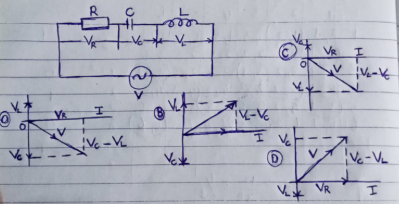
A series R - L - C circuit is shown in the diagram above. Which of the following vector diagrams correctly represents the phase relationship among I, V, V\(_F\), V\(_C\), and V\(_L\), if V\(_C\) is greater than V\(_L\) and the symbols have their usual meaning?
Attached Figure / Diagram
A
A
B
B
C
C
D
D
medium Difficulty
Verified Correct Answer: Option A
Physical Principles & Numerical Solution
i.e V\(_L\) - V\(_C\) = -ve (V\(_C\) - V\(_L\) = +ve)
From Tan \(\phi\) = \(\frac{V_L - V_C}{\text{R}}\)
It shows that V\(_L\) - V\(_C\) will be inverted on the y-axis V\(_C\) > V\(_L\)
Source: WAEC / JAMB / NECO Classroom Archive (Record #76398)
Physics
WAEC / WASSCE 2025
Simple Ac Circuit
Diagram
Solution
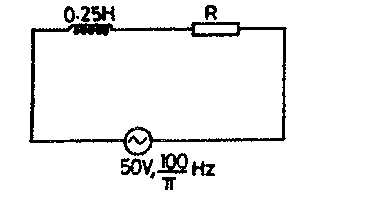
If the current in the resistor R is 0.05 A, calculate the p.d across the inductor.
Attached Figure / Diagram
A
2.5 V
B
49.0 V
C
25.0 V
D
50.0 V
medium Difficulty
Verified Correct Answer: Option A
Physical Principles & Numerical Solution
I = 0.05 A, p.d across R\(_L\) = V\(_L\) = I R\(_L\) = 0.05 \times 50
V\(_L\) = 2.5 V
Source: WAEC / JAMB / NECO Classroom Archive (Record #76399)
Physics
WAEC / WASSCE 2025
Simple Ac Circuit
Solution
A capacitor of capacitance 25μF is connected to an a.c power source of frequency \(\frac{200}{π}\) Hz. Calculate the reactance of the capacitor.
A
100.00 Ω
B
0.02 Ω
C
0.01 Ω
D
50.00 Ω
medium Difficulty
Verified Correct Answer: Option A
Physical Principles & Numerical Solution
X\(_C\) = \(\frac{1}{(2\pifC)}\) = \(\frac{1}{(2\pi \times (\frac{200}{\pi}) \times 25 \times 10^{-6})}\)
= \(\frac{1}{(2 \times 200 \times 25 \times 10^{-6})}\) = \(\frac{1}{10^{-2}}\) = 10\(^2\) = 100 \Omega
\(\therefore\) X\(_C\) = 100 \Omega
Source: WAEC / JAMB / NECO Classroom Archive (Record #76400)
Physics
WAEC / WASSCE 2025
Simple Ac Circuit
Diagram
Solution
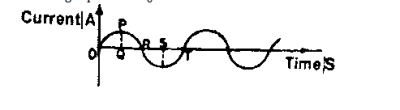
An alternating current, having a waveform shown in the diagram above, is represented by the equation X = X\(_o\) sinωt. Which of the following represents X\(_o\)?
Attached Figure / Diagram
A
OS
B
PQ
C
RT
D
OR
medium Difficulty
Verified Correct Answer: Option B
Physical Principles & Numerical Solution
X\(_o\) equals PQ because it is the amplitude or maximum current.
Source: WAEC / JAMB / NECO Classroom Archive (Record #76405)
Physics
WAEC / WASSCE 2025
Simple Ac Circuit
Diagram
Solution
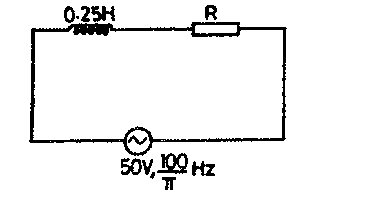
Calculate the inductive reactance of the circuit shown above
Attached Figure / Diagram
A
50.0\(\Omega\)
B
0.50\(\Omega\)
C
5.00\(\Omega\)
D
0.05\(\Omega\)
medium Difficulty
Verified Correct Answer: Option A
Physical Principles & Numerical Solution
R\(_L\) = 2\(\pi\)fL = 2 \(\pi\) x \(\frac{100}{\pi}\) x 0.25 = 50.0\(\Omega\)
Source: WAEC / JAMB / NECO Classroom Archive (Record #76441)
Physics
UTME / JAMB 2025
Semi Conductor
Solution
Charge carriers in doped semiconductors are
A
electrons and protons
B
electrons and neutrons
C
anions and cations
D
electrons and holes
medium Difficulty
Verified Correct Answer: Option D
Physical Principles & Numerical Solution
Electrical conduction in semiconductors occurs via electrons and holes.
Source: WAEC / JAMB / NECO Classroom Archive (Record #74370)
Physics
UTME / JAMB 2025
Structure of the Nucleus
Solution
Calculate the decay constant of a radioactive isotope of half-life 138.5 s.
A
5.0 × 10\(^{-3}\) s\(^{-1}\)
B
5.1 × 10\(^{-3}\) s\(^{-1}\)
C
4.9 × 10\(^{-3}\) s\(^{-1}\)
D
5.2 × 10\(^{-3}\) s\(^{-1}\)
medium Difficulty
Verified Correct Answer: Option A
Physical Principles & Numerical Solution
Answer: A
\lambda = \(\frac{ln2}{T½ }\) ⇒ \(\frac{0.693}{138.5}\) ≈ 5.0 \times 10\(^{-3}\) s\(^{-1}\).
Source: WAEC / JAMB / NECO Classroom Archive (Record #74374)
Physics
UTME / JAMB 2025
Structure of the Nucleus
Solution
One of the following is not a radiation detector
A
Electrophorus
B
Scintillation chamber
C
Geiger muller counter
D
Film badge
medium Difficulty
Verified Correct Answer: Option A
Physical Principles & Numerical Solution
A. Electrophorus. It generates static electricity via induction and is not a radiation detector. The others are:
Scintillation chamber: Detects radiation via light flashes.
Geiger-Muller counter: A gas-filled detector for ionizing radiation.
Film badge: Records cumulative radiation exposure on photographic film.
Source: WAEC / JAMB / NECO Classroom Archive (Record #74557)
Physics
UTME / JAMB 2025
Reflection of Light
Solution
A concave mirror of focal length 20cm produces an erect image that is four times the object, the object distance from the mirror is
A
less than 20cm
B
Between 20cm and30cm
C
Between 30cm and 40cm
D
Greater than 40cm
medium Difficulty
Verified Correct Answer: Option A
Physical Principles & Numerical Solution
A. Less than 20 cm
For a concave mirror, an erect image is virtual (behind the mirror) and forms when the object is placed between the pole and focus (\( u < f \)).
Magnification:
\(m = +4 \quad (\text{erect, so positive})\)
Using the mirror formula:
\(\frac{1}{v} + \frac{1}{u} = \frac{1}{f}\)
Given \( f = -20 \, \text{cm} \) (concave), \( u \) is negative.
Since \( m = -\frac{v}{u} \):
\(v = -m u = -(+4)u = -4u\)
Substituting into the mirror formula:
\(\frac{1}{-4u} + \frac{1}{u} = \frac{1}{-20}\)
Combining the fractions:
\(\frac{3}{4u} = \frac{1}{-20}\)
Thus, solving for \( u \):
\(3 \cdot -20 = 4u \quad \Rightarrow \quad u = -15 \, \text{cm}\)
Object distance \( |u| = 15 \, \text{cm} < 20 \, \text{cm} \).
Thus, it is less than 20 cm.
OR
A concave mirror only gives an erect, magnified image when the object is placed between the mirror and its focal point. Since the focal length is 20 cm, the object must be closer than 20 cm to the mirror.
Source: WAEC / JAMB / NECO Classroom Archive (Record #74541)
Physics
UTME / JAMB 2025
Reflection of Light
Solution
A 25cm long pinhole camera produces a one-fifth of an object's size. Calculate the object distance
A
20.49m
B
2.82m
C
4.23m
D
1.25m
medium Difficulty
Verified Correct Answer: Option D
Physical Principles & Numerical Solution
D. 1.25 m
In a pinhole camera, the relationship between image size and object size is given by:
\(\frac{\text{Image Size}}{\text{Object Size}} = \frac{v}{u}\)
where \( v \) is the camera length. Given \( v = 25 \, \text{cm} = 0.25 \, \text{m} \).
The image is one-fifth the object size, so the magnification is:
\(\text{Magnification} = \frac{1}{5} = \frac{v}{u}\)
Thus, we can rearrange this to find \( u \):
\(u = 5v = 5 \times 0.25 = 1.25 \, \text{m}\).
Source: WAEC / JAMB / NECO Classroom Archive (Record #74547)
Physics
UTME / JAMB 2025
Reflection of Light
Solution
If 10 objects, tinsels are placed between the mirror of a Kaleidoscope with an inclination of 30º, how many images are formed?
A
110
B
181
C
142
D
210
medium Difficulty
Verified Correct Answer: Option A
Physical Principles & Numerical Solution
In a kaleidoscope (two plane mirrors inclined at an angle ( \theta )):
\(\text{Number of images of one object} = \frac{360^\circ}{\theta} - 1\)
Given: \(\theta = 30^\circ\)
\(\frac{360}{30}\) = 12
So, images formed by one object: 12 - 1 = 11
For 10 objects (tinsels):
10 x 11 = 110 images formed.
Source: WAEC / JAMB / NECO Classroom Archive (Record #74564)
Physics
UTME / JAMB 2025
Reflection of Light
Solution
An annular eclipse is formed when
A
The sun, moon, and earth comes in straight line
B
One of the sun, moon, and earth are not visible
C
Two or more stars gathered together
D
The Earth comes between the moon and the sun
medium Difficulty
Verified Correct Answer: Option A
Physical Principles & Numerical Solution
Annular Eclipse: Occurs when the Sun, Moon, and Earth are aligned in a straight line, but the Moon is at a distance where it does not completely cover the Sun.
Source: WAEC / JAMB / NECO Classroom Archive (Record #74568)
Physics
WAEC / WASSCE 2025
Reflection of Light
Solution
Light travels in straight lines. In which of the following is this principle manifested? I. Pinhole camera II. Formation of shadows III. Diffraction of light IV. Occurrence of an eclipse.
A
I, II, and III only
B
I, II, and IV only
C
II, and III only
D
I and III only
medium Difficulty
Verified Correct Answer: Option B
Physical Principles & Numerical Solution
Pinhole camera, shadow formation, and the occurrence of an eclipse are a result of the rectilinear propagation of light.
Source: WAEC / JAMB / NECO Classroom Archive (Record #76367)
Physics
WAEC / WASSCE 2025
Reflection of Light
Solution
Which of the following is not self-luminous?
A
Incadescent flourescent tube
B
Lighted candle
C
The moon
D
Incadescent electric bulb
medium Difficulty
Verified Correct Answer: Option C
Physical Principles & Numerical Solution
The moon is not self-luminous. Self-luminous objects are those that can emit light on their own. The moon does not emit light; it only reflects light from the sun.
Source: WAEC / JAMB / NECO Classroom Archive (Record #76369)
Physics
WAEC / WASSCE 2025
Reflection of Light
Solution
An object is placed on the principal axis and at the centre of curvature of a concave mirror. The image of the object formed by the mirror is
A
real and diminished
B
at the principal focus
C
real, inverted, and magnified
D
at the centre of curvature
medium Difficulty
Verified Correct Answer: Option D
Physical Principles & Numerical Solution
When the object is placed exactly at the centre of curvature, the image forms at the same location (centre of curvature), real, inverted, and the same size.
Source: WAEC / JAMB / NECO Classroom Archive (Record #76371)