Question Library
Browse, filter, and study verified past examination questions with step-by-step mathematical reasoning.
Searching 18,000+ Questions...
Sifting topics, KaTeX formulas & verified solutions
Showing 136–150 of 1462 verified questions
Sort by:
Mathematics
WAEC / WASSCE 2020
Geometry and Trigonometry
Solution
(a) Copy and complete the table of values for the relation y = 3 sin 2x.
x
o\(^o\)
15\(^o\)
30\(^o\)
45\(^o\)
60\(^o\)
75\(^o\)
90\(^o\)
105\(^o\)
120\(^o\)
135\(^o\)
\(^o\)
y
0.0
1.5
-2.6
(b) Using a scale of 2 cm to 15^\circ on the x-axis and 2cm to I unit on the y-axis, draw the graph of y = 3 sin 2x for 0^\circ \(\geq\) x \(\geq\) 150^\circ.
(c) Use the graph to find the truth set of;
(i) 3 sin 2x + 2 = 0;
(ii ) \(\frac{3}{2}\) sin 2x = 0.25.
medium Difficulty
Verified Correct Answer: Option
Step-by-Step Mathematical Solution
x
o\(^o\)
15\(^o\)
30\(^o\)
45\(^o\)
60\(^o\)
75\(^o\)
90\(^o\)
105\(^o\)
120\(^o\)
135\(^o\)
\(^o\)
y
0.0
1.5
2.6
2.1
2.6
1.5
0
- 1.5
- 2.6
- 3
-2.6
y = 35m\(^2\)x
when x = 15\(^o\)
y = 3 sin = (15\(^o\))
y = sin 30\(^o\)
y = 3 x \(\frac{1}{2}\) = 1.5
When x = 30\(^o\)
y = 3 sin 2(30\(^o\))
y = 3 sin 60\(^o\) = 2.6
When x = 45\(^o\)
y = 3sin45\(^o\)
= 2.1
When x = 60\(^o\)
y = 3 sin 2(60\(^o\))
= 2 sin 120\(^o\)
= 2.6
When x = 75\(^o\)
y = 3 sin 2(75\(^o\))
= 3 sin 150\(^o\)
= 1.5
When x = 90\(^o\)
y = 3 sin 2(90\(^o\))
= 3 sin 180\(^o\)
= 0
When x = 105\(^o\)
y = 3 sin 2(105\(^o\))
= sin 210\(^o\)
= -1.5
When x = 120\(^o\)
y = 3 sin 2(120\(^o\))
= 3 sin 240\(^o\)
= -2.6
When x = 135\(^o\)
y = 3 sin 2(135\(^o\))
y = 3 sin 270\(^o\)
y = -3
(b
SEE THE GRAPH ABOVE...
(c)(i) 113
(ii) 3\(^o\) and 82\(^o\)
Source: Myschool Past Questions Archive (Record #58711)
Mathematics
WAEC / WASSCE 2020
Geometry and Trigonometry
Solution
(a) Two cyclists X and Y leave town Q at the same time. Cyclist X travels at the rate of 5 km/h on a bearing of 049^\circ and cyclist Y travels at the rate of 9 km/h on a bearing of 319^\circ.
(a) Illustrate the information on a diagram.
(b) After travelling for two hours, calculate. correct to the nearest whole number, the:
(i) distance between cyclist X and Y;
(ii) bearing of cyclist X from Y.
(c) Find the average speed at which cyclist X will get to Y in 4 hours.
medium Difficulty
Verified Correct Answer: Option
Step-by-Step Mathematical Solution
(a) diagram above
(b)(i) m\(^2\) = 5\(^2\) + 9\(^2\)
m\(^2\) = 25 + 81
m\(^2\) = 106
m = \(\sqrt{106}\) = 10.296 km/hr
Speed = \(\frac{distance}{times}\)
distance = speed x time
= 10.296 x 2
= 21km
(b)(ii)
tan\(\theta\) = \(\frac{9km/hr}{5km/hr}\)
tan\(\theta\) = 1.8
\(\theta\) = tan\(^{-1}\)
\(\theta\) = 60.9\(^o\)
the bearing of cyclist x from y
90\(^o\) + 19.9\(^o\) = 109.9\(^o\)
= 110\(^o\)
(c) The average speed = \(\frac{distance }{time}\)
= \(\frac{21}{4}\)km
= 5km/her
Source: Myschool Past Questions Archive (Record #58714)
Mathematics
WAEC / WASSCE 2020
Geometry and Trigonometry
Solution
The table shows the distribution of marks obtained by students in an examination.
Marks (%)
0 - 9
10 - 19
20 - 29
30 - 39
40 - 49
50 - 59
60 - 69
70 - 79
80 - 89
90 - 99
Frequency
7
11
17
20
29
34
30
25
21
6
(a) Construct a cumulative frequency table for the distribution.
(b) Draw the cumulative frequency curve for the distribution.
(c) Using the curve, find correct to one decimal place, the:
(i) median mark;
(ii) lowest mark for the distinction if 5% of the students passed with distinction
medium Difficulty
Verified Correct Answer: Option
Step-by-Step Mathematical Solution
Marks
Upper
Class
Boundary
Frequency (F)
Cumulative
Frequency (F)
(CF)
0 - 9
10 - 19
20 - 29
30 - 39
40 - 49
50 - 59
60 - 69
70 - 79
80 - 89
90 - 99
9.5
19.5
29.5
39.5
49.5
59.5
69.5
79.5
89.5
99.5
7
11
17
20
29
34
30
25
21
6
7
18
35
55
84
118
148
173
194
200
(b)
(c) (I) Median Mark = 54.5
(ii) Lowest mark, if 5% of the students passed = 14
Source: Myschool Past Questions Archive (Record #58715)
Mathematics
WAEC / WASSCE 2020
Geometry and Trigonometry
Diagram
Solution
(a) In the diagram, AB is a tangent to the circle with centre O, and COB is a straight line. If CD//AB and < ABE = 40^\circ, find: < ODE.
(b) ABCD is a parallelogram in which |\(\overline{CD}\)| = 7 cm, I\(\overline{AD}\)I = 5 cm and < ADC= 125^\circ.
(i) Illustrate the information in a diagram.
(ii) Find, correct to one decimal place, the area of the parallelogram.
(c) If x = \(\frac{1}{2}\)(1 - \(\sqrt{2}\)). Evaluate (2x\(^2\) - 2x).
Attached Figure / Diagram

medium Difficulty
Verified Correct Answer: Option
Step-by-Step Mathematical Solution
< AOB = 108\(^o\) - (90\(^o\) + 40\(^o\))
= 180\(^o\) - 130\(^o\) = 50\(^o\)
< DCO = 40\(^o\) (Alternate angle)
< ODE = \(\frac{180^o - 80^o}{2}\) = \(\frac{100^o}{2}\)
= 50\(^o\)
(b)(i)
(b)(ii) Area of the parallelogram
= ab sin \(\theta\)
= 5cm x 7cm sin 125\(^3\)
= 35 sin 125
= 28.7cm\(^2\)
(c)
x = \(\frac{1}{2}(1 - \sqrt{2})\)
evaluate (2x\(^2\) - 2x)
= 2[\(\frac{1}{2}(1 - \sqrt{2})^2\)] - 2[\(\frac{1}{2} (1 - \sqrt{2}\))]
= 2[\(\frac{1}{4}(1 - 2\sqrt{2} + 2)\)] - 1 + \(\sqrt{2}\)
= 2[\(\frac{1}{4}(3 - 2\sqrt{2})\) - 1 + \(\sqrt{2}\)]
2[\(\frac{3}{4} - \frac{1}{2} \sqrt{2} - 1 + \sqrt{2}\)]
= \(\frac{3}{2} - \sqrt{2} - 2 + 2\sqrt{2}\)
= \(\frac{1}{2} + \sqrt{2}\)
Source: Myschool Past Questions Archive (Record #58717)
Mathematics
WAEC / WASSCE 2019
Geometry and Trigonometry
Diagram
Solution
In the diagram, RT is a tangent to the circle at R, < PQR = 70\(^o\), < QRT = 52\(^o\), < QSR and < PRQ = x. Calculate the value of x.
Attached Figure / Diagram
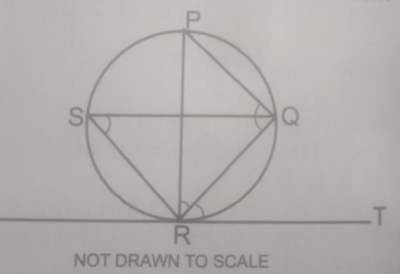
A
70\(^o\)
B
58\(^o\)
C
55\(^o\)
D
48\(^o\)
medium Difficulty
Verified Correct Answer: Option B
Step-by-Step Mathematical Solution
x = 180\(^o\) - (52\(^o\) + 70\(^o\))
= 180\(o\) - 122\(^o\)
= 58\(^o\)
Source: WAEC / JAMB / NECO Classroom Archive (Record #57380)
Mathematics
WAEC / WASSCE 2019
Geometry and Trigonometry
Diagram
Solution
In the diagram, PQ is parallel to RS, < QFG = 105\(^o\) and < FEG = 50\(^o\). Find the value of n
Attached Figure / Diagram
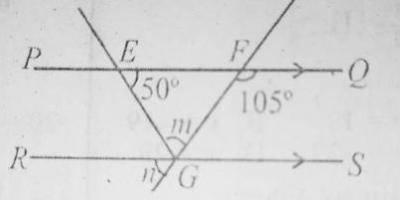
A
40\(^o\)
B
55\(^o\)
C
75\(^o\)
D
130\(^o\)
medium Difficulty
Verified Correct Answer: Option C
Step-by-Step Mathematical Solution
E\(G\)R = 50\(^o\) (Alternative angles)
n + 55\(^o\) + 50\(^o\) = 180\(^o\) (Sum of angles on a straight line)
n = 180\(^o\) - 105\(^o\)
n = 75\(^o\)
Source: WAEC / JAMB / NECO Classroom Archive (Record #57384)
Mathematics
UTME / JAMB 2019
Geometry and Trigonometry
Solution
The angle of elevation of the top of a tree from a point on the ground 60m away from the foot of the tree is 78^\circ. Find the height of the tree correct to the nearest whole number.
A
148m
B
382m
C
282m
D
248m
medium Difficulty
Verified Correct Answer: Option C
Step-by-Step Mathematical Solution
\(\tan 78 = \frac{h}{60}\)
\(h = 60 \tan 78\)
\(h = 60 \times 4.705 = 282.27m\)
\(\approxeq\) 282m to the nearest whole number.
Source: Myschool Past Questions Archive (Record #54944)
Mathematics
UTME / JAMB 2019
Geometry and Trigonometry
Solution
Age in years
7
8
9
10
11
No of pupils
4
13
30
44
9
The table above shows the number of pupils in a class with respect to their ages. If a pie chart is constructed to represent the age, the angle corresponding to 8 years old is
A
48.6°
B
56.3°
C
46.8°
D
13°
medium Difficulty
Verified Correct Answer: Option C
Step-by-Step Mathematical Solution
Total number of pupils : 4 + 13 + 30 + 44 + 9 = 100
The number of 8 - year olds = 13
The angle represented by the 8-year olds on the pie chart = \(\frac{13}{100} \times 360^\circ\)
= 46.8^\circ
Source: Myschool Past Questions Archive (Record #54946)
Mathematics
UTME / JAMB 2019
Geometry and Trigonometry
Diagram
Solution
Find the length of the chord |AB| in the diagram shown above.
Attached Figure / Diagram
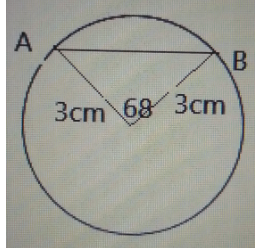
A
4.2 cm
B
4.3 cm
C
3.2 cm
D
3.4 cm
medium Difficulty
Verified Correct Answer: Option D
Step-by-Step Mathematical Solution
Length of chord = \(2r \sin (\frac{\theta}{2})\)
= \(2(3) \sin (\frac{68}{2})\)
= \(6 \sin 34\)
= \(6 \times 0.559\)
= 3.354 cm \(\approxeq\) 3.4 cm
Source: Myschool Past Questions Archive (Record #54955)
Mathematics
UTME / JAMB 2019
Geometry and Trigonometry
Solution
Given \(\sin 58^\circ = \cos p^\circ\), find p.
A
48°
B
58°
C
32°
D
52°
medium Difficulty
Verified Correct Answer: Option C
Step-by-Step Mathematical Solution
\(\sin \theta = \cos (90 - \theta)\)
\(\sin \theta = \cos (90 - 58)\)
= \(\cos 32\)
Source: Myschool Past Questions Archive (Record #54956)
Mathematics
UTME / JAMB 2019
Geometry and Trigonometry
Solution
The locus of a point which moves so that it is equidistant from two intersecting straight lines is the
A
bisector of the two lines
B
line parallel to the two lines
C
angle bisector of the two lines
D
perpendicular bisector of the two lines
medium Difficulty
Verified Correct Answer: Option C
Step-by-Step Mathematical Solution
The locus of a points equidistant from two intersecting straight lines is a pair of bisectors that bisect the angles formed by the two intersecting lines.
Source: Myschool Past Questions Archive (Record #54974)
Mathematics
UTME / JAMB 2019
Geometry and Trigonometry
Diagram
Solution
From the cyclic quadrilateral MNOP above, find the value of x.
Attached Figure / Diagram
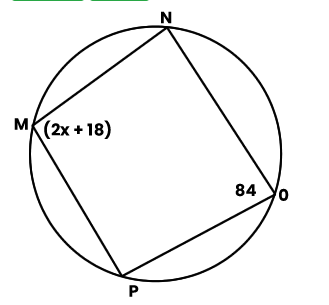
A
16°
B
25°
C
42°
D
39°
medium Difficulty
Verified Correct Answer: Option D
Step-by-Step Mathematical Solution
The sum of two opposite angles of a cyclic quadrilateral = 180^\circ
\(\therefore\) (2x + 18)^\circ + 84^\circ = 180^\circ
2x + 102^\circ = 180^\circ \(\implies\) 2x = 78^\circ
x = 39^\circ
Source: Myschool Past Questions Archive (Record #54977)
Mathematics
UTME / JAMB 2019
Geometry and Trigonometry
Solution
If \(4\sin^2 x - 3 = 0\), find the value of x, when 0^\circ \(\leq\) x \(\leq\) 90^\circ
A
90°
B
45°
C
60°
D
30°
medium Difficulty
Verified Correct Answer: Option C
Step-by-Step Mathematical Solution
\(4\sin^2 x - 3 = 0\)
\(4 \sin^2 x = 3 \implies \sin^2 x = \frac{3}{4}\)
\(\sin x = \frac{\sqrt{3}}{2}\)
\(\therefore x = \sin^{-1} (\frac{\sqrt{3}}{2})\)
x = 60^\circ
Source: Myschool Past Questions Archive (Record #54992)
Mathematics
UTME / JAMB 2019
Geometry and Trigonometry
Solution
If P(2, m) is the midpoint of the line joining Q(m, n) and R(n, -4), find the values of m and n.
A
m = 0, n = 4
B
m = 4, n = 0
C
m = 2, n = 2
D
m = -2, n = 4
medium Difficulty
Verified Correct Answer: Option A
Step-by-Step Mathematical Solution
Q(m, n) and R(n, -4)
Midpoint : P(2, m)
\(\implies (\frac{m + n}{2}, \frac{n - 4}{2}) = (2, m)\)
\(m + n = 2 \times 2 \implies m + n = 4 ... (i)\)
\(n - 4 = 2 \times m \implies n - 4 = 2m ... (ii)\)
Solving (i) and (ii) simultaneously,
m = 0 and n = 4.
Source: Myschool Past Questions Archive (Record #55019)
Mathematics
UTME / JAMB 2019
Geometry and Trigonometry
Solution
The angles of a polygon are given by 2x, 5x, x and 4x respectively. The value of x is
A
31°
B
30°
C
26°
D
48°
medium Difficulty
Verified Correct Answer: Option B
Step-by-Step Mathematical Solution
Since there are 4 angles given, the polygon is a quadrilateral.
Sum of angle in a quadrilateral = 360^\circ
\(\therefore\) 2x + 5x + x + 4x = 360^\circ
12x = 360^\circ
x = 30^\circ
Source: Myschool Past Questions Archive (Record #55081)