Question Library
Browse, filter, and study verified past examination questions with step-by-step mathematical reasoning.
Searching 18,000+ Questions...
Sifting topics, KaTeX formulas & verified solutions
Showing 136–150 of 4910 verified questions
Sort by:
Mathematics
WAEC / WASSCE 2025
Geometry and Trigonometry
Diagram
Solution
a. In the diagram above, PQSR and SRYZ are parallelograms, and PQYZ is a straight line. If |QY| = 2cm and |RS| = 3cm, find |PZ|
b. P and Q are two towns on the Earth's surface on latitude of 56^\circN. Their longitudes are 25^\circE and 95^\circE, respectively. Find the distance PQ along their parallel of latitude, correct to the nearest km. [Take radius of the earth as 6400 km and \pi = \(\frac{22}{7}\)]
Attached Figure / Diagram

medium Difficulty
Verified Correct Answer: Option
Step-by-Step Mathematical Solution
a. From the figure: |PZ| = |PQ| + |QY| + |YZ|
|PQ| = |RS| = 3 cm (opposite sides of a parallelogram)
|YZ| = |RS| = 3 cm (opposite sides of a parallelogram)
|QY| = 2 cm (given)
|PZ| = |PQ| + |QY| + |YZ|
|PZ| = 3 + 2 + 3 = 8 cm
b. radius of latitude r = R cos \alpha,
where \alpha is the angle 56º
r = 6400 cos 56^\circ = 3578.8 km
< PLQ = 95º - 25^\circ = 70^\circ
Length of arc PQ = \(\frac{\theta}{360}\) \times 2\pir
= \(\frac{70}{360}\) \times 2 \times (\(\frac{22}{7}\)) \times 3578.8 = \(\frac{39367.2}{9}\) = 4374 km
Source: Myschool Past Questions Archive (Record #75921)
Mathematics
WAEC / WASSCE 2025
Number and Numeration
Solution
The frequency table shows the marks scored by 32 students in a test.
Marks scored
1
2
3
4
5
6
7
8
9
10
Number of students
2
3
4
4
4
4
5
3
2
1
a(i) Find the mean of the marks
(ii) Find the median of the marks
(iii) Find the mode of the marks
b. Percentage of those who scored at least 8 marks
medium Difficulty
Verified Correct Answer: Option
Step-by-Step Mathematical Solution
a(i) Σfx =2 + 6 +12 + 16 + 20 + 24 + 35 + 24 +18 +10 = 167
Mean = \(\frac{Σfx}{Σf}\) =\(\frac{167}{32}\) = 5.22
ii. Median = Middle Position Value = \(\frac{\text{N}}{2}\)th position
= \(\frac{32}{2}\) position = 16 th position
.: Median = 5
iii. Mode = most people => highest frequency
.: Mode = 7
b. People scoring at least 8 marks => frequency of x > = 8 = 3 + 1 + 2 = 6
Percentage = \(\frac{6}{32}\) x 100% = 18.75%
Source: Myschool Past Questions Archive (Record #75923)
Mathematics
WAEC / WASSCE 2025
Number and Numeration
Diagram
Solution
PART TWO
ai Using mathematical tables, find: 2sin63.35º
ii Using mathematical tables, find: log cos 44.74º
iii Find the value of k given that log k - log(k - 2) = log 5
b) Use logarithm tables to evaluate: \(\frac{3.68^2 \times 6.705}{\sqrt{0.3581}}\)
Attached Figure / Diagram

medium Difficulty
Verified Correct Answer: Option
Step-by-Step Mathematical Solution
ai From the four-figure/ mathematical table 2sin63.35º = 2(0.8938) = 1.7876
ii. From the four-figure/ mathematical table, log cos 44.74º = log 0.7103 = \(\bar{1}\).8515
iii. log k - log(k - 2) = log 5 = log \(\frac{\text{k}}{k - 2}\) = log 5 (law of logarithms)
log \(\frac{\text{k}}{k - 2}\) = log 5
\(\frac{\text{k}}{k - 2}\) = 5
cross multiply
5(k - 2) = k
5k - 10 = k
5k - k = 10
4k = 10
k = \(\frac{10}{4}\) = \(\frac{5}{2}\).
b. \(\frac{3.68^2 \times 6.705}{\sqrt{0.3581}}\) = 151.8. See the steps in the diagram above.
Source: Myschool Past Questions Archive (Record #75924)
Mathematics
WAEC / WASSCE 2025
Algebra
Solution
a. Given that p = x + ym\(^3\), find m in terms of p, x, and y
b. Using the method of completing the square method, find the roots of the quadratic equation x\(^2\) - 6x + 7 = 0 to 1 decimal place.
c. The product of two consecutive positive odd numbers is 195. By constructing a quadratic equation and solving it. Find the two numbers.
medium Difficulty
Verified Correct Answer: Option
Step-by-Step Mathematical Solution
a. p = x + ym\(^3\)
ym\(^3\) = p - x
m\(^3\) = \(\frac{p - x}{\text{y}}\)
\(m = \sqrt[3]{\frac{p - x}{y}}\).
b. x\(^2\) - 6x + 7 = 0
Using the completing the square method
x\(^2\) - 6x = - 7
Add the square of half the coefficient of x to both sides
x\(^2\) - 6x + (-3)\(^2\) = -7 + 9
x\(^2\) - 6x + (-3)\(^2\) = 2
(x - 3)\(^2\) = 2
x - 3 = \pm \(\sqrt{2}\)
x = 3 + \(\sqrt{2}\) or 3 - \(\sqrt{2}\)
x = 3 + 1.4142 or 3 - 1.4142
x = 4.1 or 1.6 to 1 decimal place.
c. Let the two consecutive positive odd numbers be \(n\) and \(n + 2\).
The equation for their product is:
\(n(n + 2) = 195\)
Expanding gives:
n\(^2\) + 2n - 195 = 0
Using the quadratic formula:
\(n = \frac{-b \pm \sqrt{b^2 - 4ac}}{2a}\)
with \(a = 1\), \(b = 2\), and \(c = -195\):
\(b^2 - 4ac = 2^2 - 4 \cdot 1 \cdot (-195) = 4 + 780 = 784\)
Now substituting: \(n = \frac{-2 \pm \sqrt{784}}{2} = \frac{-2 \pm 28}{2}\)
This results in: \(n = \frac{26}{2} = 13 \quad (\text{positive solution})\)
Thus, the two numbers are: \(13 \quad \text{and} \quad 15\)
Source: Myschool Past Questions Archive (Record #75925)
Mathematics
WAEC / WASSCE 2025
Geometry and Trigonometry
Solution
ai. A man travels from a village X on a bearing of 060º to a village Y, which is 20 km away. From Y, he travels to a village Z, on a bearing of 195º. If Z is directly east of X, calculate, correct to three significant figures, the distance of Y from Z
ii. A man travels from a village X on a bearing of 060º to a village Y, which is 20 km away. From Y, he travels to a village Z, on a bearing of 195º. If Z is directly east of X, calculate, correct to three significant figures, the distance of Z from X
bi. An aircraft flies due south from an airfield on latitude 36ºN, longitude 138ºE to an airfield on latitude 36^\circS, longitude 138ºE. Calculate the distance travelled, correct to three significant figures.
ii. An aircraft flies due south from an airfield on latitude 36ºN, longitude 138ºE to an airfield on latitude 36ºS, longitude 138ºE. If the speed of the aircraft is 800 km per hour, calculate the time taken, correct to the nearest hour. [Take \pi = \(\frac{22}{7}\), R = 6400 km]
medium Difficulty
Verified Correct Answer: Option
Step-by-Step Mathematical Solution
ai. ∠Y = 270º - (195^\circ + 30^\circ) = 270^\circ - 225^\circ = 45º
∠Z = 180º - (30^\circ + 45º) = 105º
Let the distance of Y from Z be k
\(\frac{\text{k}}{sin30º} = \frac{20}{sin 105º}\)
k sin 105º = 20 sin 30º
k = \(\frac{20 sin 30^\circ}{ sin 105^\circ}\) = \(\frac{20 \times 0.5 }{sin 105^\circ}\) = \(\frac{10}{0.9659}\) = 10.35
⇒ k = 10.4 km (3. s.f.)
ii. Let the distance of Z from X be t
Using the sine rule
\(\frac{\text{t}}{sin 30º} = \frac{20}{sin 105º}\)
t sin 105^\circ = 20 sin 45^\circ
t = \(\frac{20 sin 45º}{sin 105º}\)
t = 14.6km to 3. s.f
bi. Latitudinal difference = 36^\circ + 36^\circ = 72^\circ
Distance PQ = Length of arc PQ
= \(\frac{\theta}{360}\) \times 2\piR = \(\frac{72}{360}\) \times 2 \times \(\frac{22}{7}\) \times 6400 km
= \(\frac{88 \times 640}{ 7 }\) = \(\frac{56320}{7}\) = 8045.7 km = 8050 km (3 s.f.)
ii. Speed of aircraft = 800 km/hr
Time taken = \(\frac{\text{Total distance}}{\text{Speed}}\) = \(\frac{8050}{800}\) = 10.05 hrs
Source: Myschool Past Questions Archive (Record #76101)
Mathematics
WAEC / WASSCE 2025
Statistics and Probability
Solution
a. The table shows the scores of 2000 candidates in an entrance examination into a private secondary school.
% mark
11 - 20
21 - 30
31 - 40
41 - 50
51 - 60
61 - 70
71 - 80
81-90
Number of pupils
68
184
294
402
480
310
164
98
Prepare a cumulative frequency table and draw the cumulative frequency curve for the distribution.
bi. Use the curve to estimate the cut-off mark if 300 candidates are to be offered admission.
bii. Use your curve to estimate the probability that a candidate picked at random scored at least 45%
medium Difficulty
Verified Correct Answer: Option
Step-by-Step Mathematical Solution
a.
x
f
cum. frequency
End point
11-20
68
68
20.5
21-30
184
252
30.5
31-40
294
546
40.5
41-50
402
948
50.5
50-60
480
1428
60.5
61-70
310
1738
70.5
71-80
164
1902
80.5
81-90
94
2000
90.5
bi. Cut-off mark = 64%
ii. Pr(student scoring at least 45%) = \(\frac{1075}{2000}\) = 0.5375
Source: Myschool Past Questions Archive (Record #76110)
Mathematics
WAEC / WASSCE 2025
Statistics and Probability
Solution
a. A box contains 5 blue balls, 3 black balls, and 2 red balls of the same size. A ball is selected at random from the box and then replaced. A second ball is then selected. Find the probability of obtaining: two red balls
b. A box contains 5 blue balls, 3 black balls, and 2 red balls of the same size. A ball is selected at random from the box and then replaced. A second ball is then selected. Find the probability of obtaining: two blue balls or two black balls
c. A box contains 5 blue balls, 3 black balls, and 2 red balls of the same size. A ball is selected at random from the box and then replaced. A second ball is then selected. Find the probability of obtaining: one black ball and one red ball in any order
medium Difficulty
Verified Correct Answer: Option
Step-by-Step Mathematical Solution
a. Total ball = 5 blues + 3 blacks + 2 red balls = 10 balls
Selection with replacement
Pr(1st red ball) = \(\frac{2}{10}\)
Pr(2nd red ball) = \(\frac{2}{10}\)
Therefore, Pr(two red balls) = \(\frac{2}{10}\) x \(\frac{2}{10}\) = \(\frac{4}{100}\)
= \(\frac{1}{25}\) = 0.04
b. Pr( of selecting 2 blue) = \(\frac{5}{10}\) x \(\frac{5}{10}\) = \(\frac{25}{100}\)
= \(\frac{1}{4}\)
Pr(of selecting 2 black balls) = \(\frac{3}{10}\) x \(\frac{3}{10}\) = \(\frac{9}{100}\)
Pr( 2 blue or 2 black balls) = \(\frac{1}{4}\) + \(\frac{9}{100}\) = \(\frac{25}{100}\) + \(\frac{9}{100}\) = \(\frac{34}{100}\) = 0.34.
c) 1 black, and 1 red in any other means it can be 1 black, and 1 red, and 1 black
= \(\frac{3}{10}\) x \(\frac{2}{10}\) + \(\frac{2}{10}\) + \(\frac{3}{10}\)
= \(\frac{6}{100}\) + \(\frac{6}{100}\) = \(\frac{12}{100}\) = 0.12.
Source: Myschool Past Questions Archive (Record #76113)
Mathematics
UTME / JAMB 2024
Algebra
Solution
Find x if \(\frac{16^{2 + x}}{4} = 64^x\)
A
3
B
- 3
C
5
D
- 5
medium Difficulty
Verified Correct Answer: Option A
Step-by-Step Mathematical Solution
\(\frac{16^{2 + x}}{4} = 64^x\)
16\(^{2 + x} = 4 \times 64^x\)
4\(^{2(2 + x)} = 4^1 \times 4^{3(x)}\)
(Equate coefficients since the bases are the same)
2(2 + x) = 1 + 3x
4 + 2x = 1 + 3x
2x - 3x = 1 - 4
-x = -3
x = 3.
Source: WAEC / JAMB / NECO Classroom Archive (Record #70259)
Mathematics
UTME / JAMB 2024
Geometry and Trigonometry
Solution
Find the angle subtended by an arc 33cm long of a circle of diameter 28cm.
A
105\(^0\)
B
115\(^0\)
C
120\(^0\)
D
135\(^0\)
medium Difficulty
Verified Correct Answer: Option D
Step-by-Step Mathematical Solution
Length of Arc = \(\frac{\theta}{360}\) x 2\(\pi\)r
Length of arc = 33cm, diameter = 28cm → r = 14cm
33 = \(\frac{\theta}{360} \times 2 \times \frac{22}{7}\times14\)
\(\theta\) = \(\frac{33 \times 180}{22 \times 2}\)
\(\theta\) = 135º
Source: WAEC / JAMB / NECO Classroom Archive (Record #70176)
Mathematics
UTME / JAMB 2024
Geometry and Trigonometry
Diagram
Solution
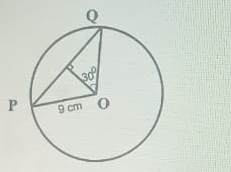
From the figure above, find the length of Chord PQ
Attached Figure / Diagram
A
17cm
B
18cm
C
7cm
D
9cm
medium Difficulty
Verified Correct Answer: Option D
Step-by-Step Mathematical Solution
Length of a chord = 2rSin\(\frac{\theta}{2}\)
\(\theta\) = 60º not 30º and radius = 9cm
Therefore, Length of the chord = 2 x 9 Sin\(\frac{60º}{2}\) = 2 x 9 x Sin 30º = 2 x 9 x \(\frac{1}{2}\) = 9cm.
Source: WAEC / JAMB / NECO Classroom Archive (Record #70182)
Mathematics
UTME / JAMB 2024
Geometry and Trigonometry
Solution
PQR is a triangle such that |PQ| = |QR| = 8cm and QPR = 60º. Find the area of \(\angle\) PQR
A
16\(\sqrt{3}cm^2\)
B
16\(\sqrt{2}cm^2\)
C
8\(\sqrt{3}cm^2\)
D
16\(\sqrt{2}cm^2\)
medium Difficulty
Verified Correct Answer: Option A
Step-by-Step Mathematical Solution
The area of a triangle given two sides and the included angle = \(\frac{1}{2}\) x a x b x Sin\(\theta\)
a = b = 8cm
\(\theta\) = 60º
Area = \(\frac{1}{2}\) x 8 x 8 x Sin 60º = \(\frac{1}{2}\) x 64 x \(\frac{\sqrt{3}}{2}\) ( Sin 60º = \(\frac{\sqrt{3}}{2}\) )
= \(\frac{64\sqrt{3}}{4}\) = 16\(\sqrt{3}cm^2\)
Source: WAEC / JAMB / NECO Classroom Archive (Record #70195)
Mathematics
UTME / JAMB 2024
Geometry and Trigonometry
Diagram
Solution
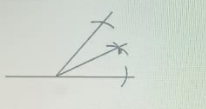
In the diagram above, T represents the construction of angle .....
Attached Figure / Diagram
A
15\(^0\)
B
30\(^0\)
C
45\(^0\)
D
60\(^0\)
medium Difficulty
Verified Correct Answer: Option B
Step-by-Step Mathematical Solution
The construction of angle 30º
(If you take a 60º angle and bisect it, you would divide it into two angles of 30º each.)
Source: WAEC / JAMB / NECO Classroom Archive (Record #70266)
Mathematics
WAEC / WASSCE 2024
Geometry and Trigonometry
Diagram
Solution
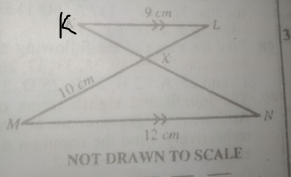
In the diagram above, \(\overline{MN} || \overline{KL}\), \(\overline{ML}\) and \(\overline{KN}\) intersect at X. |\(\overline{MN}\)| = 12cm, |\(\overline{MX}\)| = 10cm and |\(\overline{MN}\)| = 9cm. If the area of \(\triangle\) MXN is 16cm\(^2\), calculate the area of \(\triangle\) LXK
Attached Figure / Diagram
A
9cm\(^2\)
B
8cm\(^2\)
C
10cm\(^2\)
D
12cm\(^2\)
medium Difficulty
Verified Correct Answer: Option A
Step-by-Step Mathematical Solution
\(\overline{MN} || \overline{KL}\), \(\triangle\) LXK is similar to \(\triangle\)MXN
So, the ratio of the areas of the two similar triangles equals the square of the ratio of their corresponding sides
Therefore, \(\frac{ Area of \triangle MXN}{Area of \triangle LXK} = \frac{12^2}{9^2}\)
\(\frac{16}{Area of \triangle LXK} = \frac{144}{81}\)
Area of \(\triangle\)LXK = \(\frac{ 16 \times 81}{144} = 9cm^2\)
Source: WAEC / JAMB / NECO Classroom Archive (Record #71797)
Mathematics
UTME / JAMB 2024
Number Bases
Solution
Convert the number 10111.11\(_{two}\) to a mixed number.
A
23\(\frac{1}{4}\)
B
23\(\frac{3}{4}\)
C
22\(\frac{1}{4}\)
D
24\(\frac{3}{4}\)
medium Difficulty
Verified Correct Answer: Option B
Step-by-Step Mathematical Solution
10111.11\(_{two}\)
convert the number to base 10.
10111.11\(_{two}\) = 1 x 2\(^4\) + 0 x 2\(^3\) + 1 x \(^2\) + 1 x 2\(^1\) + 1 x 2\(^0\) + 1 x 2\(^{-1}\) + 1 x 2\(^{-2}\)
= 16 + 0 + 4 + 2 + 1 + \(\frac{1}{2}\) + \(\frac{1}{4}\)
= 23 + \(\frac{3}{4}\) = 23\(\frac{3}{4}\)
Source: WAEC / JAMB / NECO Classroom Archive (Record #70269)
Mathematics
UTME / JAMB 2024
Number Bases
Solution
Subtract 14256\(_{seven}\) from 20045\(_{seven}\)
A
1256\(_{seven}\)
B
2456\(_{seven}\)
C
1356\(_{seven}\)
D
2465\(_{seven}\)
medium Difficulty
Verified Correct Answer: Option B
Step-by-Step Mathematical Solution
Subtract 14256\(_{seven}\) from 20045\(_{seven}\) = 2456\(_{seven}\)
2
0
0
4
5
1
4
2
5
6
0
2
4
5
6
Source: WAEC / JAMB / NECO Classroom Archive (Record #70271)