Question Library
Browse, filter, and study verified past examination questions with step-by-step mathematical reasoning.
Searching 18,000+ Questions...
Sifting topics, KaTeX formulas & verified solutions
Showing 406–420 of 13612 verified questions
Sort by:
Physics
WAEC / WASSCE 2024
Current Electricity
Solution
To convert a milli-ammeter to an ammeter, a resistor of low value is necessary to connect a resistor of
A
low value in series with it
B
high value in series with it
C
low value in parallel with it
D
high value in parallel with it
medium Difficulty
Verified Correct Answer: Option C
Physical Principles & Numerical Solution
To change a milliammeter to an ammeter, a low resistance known as shunt must be connected to it in parallel.
Source: WAEC / JAMB / NECO Classroom Archive (Record #72038)
Physics
WAEC / WASSCE 2024
Current Electricity
Solution
The depolarizing agent in a Leclanché cell is
A
powdered carbon.
B
manganese (IV) oxide.
C
carbon rod.
D
ammonium.
medium Difficulty
Verified Correct Answer: Option B
Physical Principles & Numerical Solution
The depolarizing agent in a Leclanché cell is manganese dioxide (MnO\(_2\)). This compound helps to reduce the polarization effect and improves the efficiency of the cell during operation.
Source: WAEC / JAMB / NECO Classroom Archive (Record #72062)
Physics
WAEC / WASSCE 2024
Current Electricity
Diagram
Solution
ALTERNATIVE B
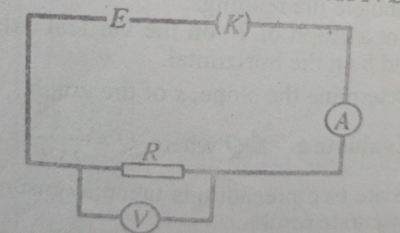
(a) You are provided with a variable DC power supply E, a key, an ammeter, a voltmeter and other necessary materials
(i) Set up a circuit as shown in the diagram above with E = 3.0V
(ii) Close the key.
(iii) Record the voltmeter reading, V
(iv) Read the corresponding ammeter reading, I
(v) Evaluate V\(^{-1}\) and I\(^{-1}\)
(vi) Repeat the procedure for the four other values of E = 4.5V, 6.0V, 7.5V and 9.0V.
(vii) Tabulate your readings.
(viii) Plot a graph with I\(^{-1}\) on the vertical axis and V\(^{-1}\) on the horizontal axis starting with both axes from the origin. (0, 0)
(ix) Determine the slope, s of the graph.
(x) Also, determine the intercept, c on the vertical axis
(xi) What does the slope, s represent?
(xii) State two precautions taken to ensure accurate results.
(b) State two methods by which an electric current can be produced
(i) State Ohm's law.
Attached Figure / Diagram
medium Difficulty
Verified Correct Answer: Option
Physical Principles & Numerical Solution
(vii)
E(V)
V(V)
I(A)
V\(^{-1}\)(V\(^{-1}\))
I\(^{-1}\)(I\(^{-1}\))
3.00
2.86
1.43
0.350
0.699
4.50
4.28
2.14
0.234
0.467
6.00
5.70
2.86
0.175
0.350
7.50
7.14
3.57
0.140
0.280
9.00
8.57
4.28
0.117
0.234
(viii) SEE THE GRAPH ABOVE
(ix) Slope = \(\frac{\Delta I^{-1}}{\Delta V^{-1}}\) = \(\frac{0.6 - 0.3}{0.3 - 0.15}\) = \(\frac{0.3}{0.15}\) = 2
(x) Intercept, c = 0.01
(xi) Slope, s represents external resistance of the circuit
(xii) I. I ensured tight connections II. I avoided error due to parallax on the ammeter/voltmeter
b(i) I. Use of cell II. hydropower
(ii) Ohm's law states that the current passing through a metallic conductor is directly proportional to the potential difference applied at both ends provided temperature remains constant.
Source: WAEC / JAMB / NECO Classroom Archive (Record #72109)
Physics
WAEC / WASSCE 2024
Simple Ac Circuit
Diagram
Solution
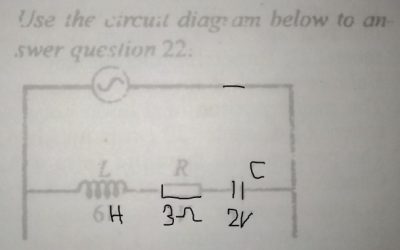
A constant voltage source supplies a sinusoidal alternating e.m.f. The voltage marked against the components are their peak values. Determine the peak value of the applied e.m.f
Attached Figure / Diagram
A
1V
B
4V
C
5V
D
2V
medium Difficulty
Verified Correct Answer: Option C
Physical Principles & Numerical Solution
Effective voltage in an RLC circuit is given by V = \(\sqrt{V_R^2 + (V_L - V_C)^2}\)
V = \(\sqrt{3^2 + (6 - 2)^2}\) = \(\sqrt{3^2 + 4^2}\) = \(\sqrt{9 + 16}\)
= 5V
Source: WAEC / JAMB / NECO Classroom Archive (Record #72054)
Physics
WAEC / WASSCE 2024
Simple Ac Circuit
Solution
A 2 μF capacitor is connected directly across a 150 V\(_{rms}\), 60 Hz A.C source. Calculate the r m s value of the current.
A
0.113 A
B
0.160 A
C
150 A
D
1324 A
medium Difficulty
Verified Correct Answer: Option A
Physical Principles & Numerical Solution
X\(_c\) = \(\frac{1}{2\pi FC}\)
X\(_c\) = \(\frac{1}{2 \times 3.142 \times 60 \times 2 \times 10^{-6}}\)
X\(_c\) = 1326.1192\(\Omega\)
I = \(\frac{\text{V}}{X_c}\)
I = \(\frac{150}{1326.1192}\) = 0.113A
Source: WAEC / JAMB / NECO Classroom Archive (Record #72056)
Physics
WAEC / WASSCE 2024
Structure of the Atom
Solution
What are cathode rays?
A
Stream of electrons
B
Beam of neutrons
C
Beam of protons
D
Stream of alpha particles
medium Difficulty
Verified Correct Answer: Option A
Physical Principles & Numerical Solution
Cathode rays are streams of electrons emitted from the cathode (negative electrode) in a vacuum tube. Cathode rays can be deflected by magnetic and electric fields, demonstrating their charge and nature as electrons.
Source: WAEC / JAMB / NECO Classroom Archive (Record #72012)
Physics
WAEC / WASSCE 2024
Structure of the Atom
Solution
Light of energy 1.12 x 10\(^{-18}\) J is incident on a metal of ejected electrons with maximum energy of 8.0 x 10\(^{-19}\)J. Calculate the threshold frequency of the metal. [h = 6.626 x 10\(^{-34}\)Js]
A
4.8 x 10\(^{14}\)Hz
B
1.2 x 10\(^{15}\)Hz
C
1.7 x 10\(^{15}\)Hz
D
2.8 x 10\(^{15}\)Hz
medium Difficulty
Verified Correct Answer: Option A
Physical Principles & Numerical Solution
E = hf + W\(_o\)
E = 1.12 x 10\(^{-18}\)J
Max. Energy = 8.0 x 10\(^{-19}\)J.
W\(_o\) = E - Max. Energy = 1.12 x 10\(^{-18}\)J - 8.0 x 10\(^{-19}\)J. = 3.2 x 10\(^{-19}\)J.
But W\(_o\) = hf\(_o\)
f\(_o\) = \(\frac{W_o}{h}\) = \(\frac{3.2 \times 10^{-19}}{6.626 \times 10^{-34}}\) = 4.83 x 10\(^{14}\)Hz
Source: WAEC / JAMB / NECO Classroom Archive (Record #72058)
Physics
WAEC / WASSCE 2024
Structure of the Atom
Solution
(a) Mention three facts about photoelectric effect
(b) An electric magnetic radiation source of power 6 x 10\(^{-3}\) W emits 1 x 10\(^{16}\) photons per second. The most energetic photo electron ejected from a metal surface is stopped by a potential difference of 2.2V. Calculate the work function of the metal. [ mass of (photon) electrons 9.1 x 10\(^{-31}\) kg, e = 1.6 x 10\(^{-19}\) C]
(c) State two factors on which the activity of a radioactive sample depends
(d) Cobalt-60 source has an activity of 2.0 x 10\(^6\) Bq and a half-life of 1.8 x 10\(^8\)s. Calculate the number of radioisotope nuclei in the source.
medium Difficulty
Verified Correct Answer: Option
Physical Principles & Numerical Solution
(a) electrons are only emitted when the photon frequency exceeds the threshold frequency,
- the energy of each photon is proportional to its frequency,
- the emission of photoelectrons depends on the frequency of incident light on the metal,
- the intensity of light does not affect the energy of the electrons emitted/photoelectrons,
- the energy of the photoelectron depends on the frequency of incident radiation.
(b) Given: P = 6 x 10\(^{-3}\) W, no of photons per seconds = 1 x 10\(^{16}\), m\(_e\) = 9.1 x 10\(^{-31}\) kg, e = 1.6 x 10\(^{-19}\) C, W\(_o\) = ?
Photon Energy E = \(\frac{\text{power}}{\text{no of photons per second}}\) = \(\frac{\text{P}}{\text{n}}\)
= \(\frac{6.0 \times 10^{-3}}{1 \times 10^{16}}\)
= 6 x 10\(^{-19}\)J
But K.E = E + W\(_o\)
W\(_o\) = E - K.E = E - eV
W\(_o\) = 6 x 10\(^{-19}\) - 2.2 x (1.6 x 10\(^{-19}\)) = 2.48 x 10\(^{-9}\)J
(c) Factors on which radioactive activity depends are: (i) decay constant, (ii) number of unstable nuclei present at a given time (iii) time of the decay process (iv) environmental conditions, (v) type of radioisotope, etc
(d) Given: A = 2.0 x 10\(^6\)Bq, t\(_{\frac{1}{2}}\) = 1.8 x 10\(^8\)s
A = \(\lambda\)N, where \(\lambda\) = decay constant, N = number of radioactive nuclei, A = activity.
But \(\lambda\) = \(\frac{In(2)}{t_{\frac{1}{2}}}\)
\(\lambda\) = \(\frac{In(2)}{1.8 \times 10^8}\) ≈ \(\frac{0.693}{1.8 \times 10^8}\) ≈ 3.85 x 10\(^{-9}\)s\(^{-1}\)
Recall, A = \(\lambda\)N
N = \(\frac{A}{\lambda}\) = \(\frac{2.0 \times 10^6}{3.85 \times 10^{-9}}\) = 5.2 x 10\(^{14}\) nuclei
Source: WAEC / JAMB / NECO Classroom Archive (Record #72095)
Physics
WAEC / WASSCE 2024
Structure of the Nucleus
Solution
All of the following uses are practical applications of x-ray except
A
the treatment of tumors
B
determining the depth of a mine
C
dental operation
D
detecting fractures in bones
medium Difficulty
Verified Correct Answer: Option B
Physical Principles & Numerical Solution
X-rays are typically used for medical imaging and other applications related to examining structures, but they are not used to determine the depth of a mine
Source: WAEC / JAMB / NECO Classroom Archive (Record #72046)
Physics
WAEC / WASSCE 2024
Structure of the Nucleus
Solution
The main difference between X-rays and gamma rays is in their
A
ionizing ability.
B
absorbing rate.
C
mode of propagation.
D
mode of production.
medium Difficulty
Verified Correct Answer: Option D
Physical Principles & Numerical Solution
X-rays are usually produced by electronic transitions within atoms, whereas gamma rays are released from an atom's nucleus during radioactive decay.
Source: WAEC / JAMB / NECO Classroom Archive (Record #72069)
Physics
WAEC / WASSCE 2024
Structure of the Nucleus
Solution
The correct sequence of ionization power of alpha particle, gamma ray, and beta particle respectively is
A
low, medium, high.
B
high, medium, low.
C
medium, low, high.
D
high, low, medium.
medium Difficulty
Verified Correct Answer: Option D
Physical Principles & Numerical Solution
The correct sequence of ionization power from highest to lowest is: Alpha particle > Beta particle > Gamma ray.
Source: WAEC / JAMB / NECO Classroom Archive (Record #72072)
Physics
WAEC / WASSCE 2024
Wave Particle Paradox
Solution
An electron of mass, m, and charge, e moves through the electric field of potential difference V\(_o\) with a speed, v. Show that de Broglie wavelength associated with the electron is given as \(\lambda\) = \(\frac{\text{h}}{\sqrt{2meV_o}}\), where h is the Plank's constant.
medium Difficulty
Verified Correct Answer: Option
Physical Principles & Numerical Solution
To show that \(\lambda\) = \(\frac{\text{h}}{\sqrt{2meV_o}}\)
The de broglie wavelength \(\lambda\), is given by
\(\lambda\) = \(\frac{\text{h}}{\text{p}}\)
where p = mv
\(\lambda\) = \(\frac{\text{h}}{\text{mv}}\)
When an electron is accelerated through a potential difference V\(_0\), it gains kinetic energy given K.E.= eV\(_0\)
The kinetic energy can also be expressed in terms of the mass m of the electron and its speed v: K.E = \(\frac{1}{2}\)mv\(^2\)
K.E = eV\(_0\) = \(\frac{1}{2}\)mv\(^2\)
v = \(\sqrt{\frac{2eV_o}{m}}\)
Substituting v = \(\sqrt{\frac{2eV_o}{m}}\) into the de Broglie equation
\(\lambda\) = \(\frac{\text{h}}{m \times \sqrt{\frac{2eV_o}{m}}}\) = \(\frac{\text{h}}{\sqrt{\frac{2eV_o m^2}{m}}}\)
\(\lambda\) = \(\frac{\text{h}}{\sqrt{2meV_o}}\)
Note: use the fact that \(\sqrt{m}\) x \(\sqrt{m}\) = m
Source: WAEC / JAMB / NECO Classroom Archive (Record #72089)
Physics
WAEC / WASSCE 2024
Reflection of Light
Solution
An object is placed 1.5 m from a plane mirror. How far is the image from the object?
A
3.0 m
B
1.3 m
C
1.0 m
D
0.3 m
medium Difficulty
Verified Correct Answer: Option A
Physical Principles & Numerical Solution
When an object is placed in front of a plane mirror, the image formed is at the same distance from the mirror as the object but on the opposite side.
Thus, the total distance between the object and the image is 1.5 m + 1.5 m = 3.0m
Source: WAEC / JAMB / NECO Classroom Archive (Record #72039)
Physics
WAEC / WASSCE 2024
Reflection of Light
Solution
An object 2.0 cm high is placed at the radius of curvature of a concave mirror such that it is perpendicular to the principal axis of the mirror. Determine the height of the image.
A
0.5 cm
B
1.0 cm
C
1.5 cm
D
2.0 cm
medium Difficulty
Verified Correct Answer: Option D
Physical Principles & Numerical Solution
When an object is placed at the centre of curvature of a concave mirror, an image that is the same as the object will be formed. Therefore, the height of the image is 2.0 cm.
Source: WAEC / JAMB / NECO Classroom Archive (Record #72059)
Physics
WAEC / WASSCE 2024
Reflection of Light
Solution
A convex mirror is used as a driving mirror; however, a disadvantage in this regard is that the image
A
it produces is virtual
B
it produces is real
C
is not as bright as we would like
D
appears farther away from the driver
medium Difficulty
Verified Correct Answer: Option D
Physical Principles & Numerical Solution
The main disadvantage of a convex mirror as a driving mirror is that it distorts the perception of distance, making them appear farther away than they are.
Source: WAEC / JAMB / NECO Classroom Archive (Record #72079)