Question Library
Browse, filter, and study verified past examination questions with step-by-step mathematical reasoning.
Searching 18,000+ Questions...
Sifting topics, KaTeX formulas & verified solutions
Showing 361–375 of 13612 verified questions
Sort by:
Biology
WAEC / WASSCE 2025
Science of Living Things
Diagram
Solution
The process occuring in the illustrated molecules above is
Attached Figure / Diagram

A
protein synthesis
B
gene coding
C
DNA replication
D
gene mutation
medium Difficulty
Verified Correct Answer: Option C
Biological Concept & Syllabus Guide
DNA replication is the essential biological process of producing two identical replicas of DNA from one original DNA molecule, occurring in all living organisms prior to cell division.
Source: Myschool Past Questions Archive (Record #77516)
Biology
WAEC / WASSCE 2025
Science of Living Things
Solution
If the percentage of adenine in the DNA of a human is 32%, what would be the percentage of thymine?
A
10%
B
16%
C
32%
D
27%
medium Difficulty
Verified Correct Answer: Option C
Biological Concept & Syllabus Guide
If the percentage of adenine (A) in human DNA is 32%, the percentage of thymine (T) would also be 32%.
This calculation is based on Chargaff's rules, which state that in a double-stranded DNA molecule, nitrogenous bases always pair in a specific manner:
Adenine (A) always pairs with Thymine (T) (A = T).
Guanine (G) always pairs with Cytosine (C) (G = C)
Source: Myschool Past Questions Archive (Record #77518)
Biology
WAEC / WASSCE 2025
Science of Living Things
Solution
Which of the following statements is not correct about colour blindness?
A
It is a sex-linked trait
B
Males are often carriers
C
females are not carriers
D
The trait is controlled by a recesive gene
medium Difficulty
Verified Correct Answer: Option C
Biological Concept & Syllabus Guide
Both statements in options B and C are not correct based on the biological principles of sex-linked inheritance:
Males cannot be carriers: Because colour blindness is an X-linked recessive trait and males have only one X chromosome, they will always express the condition if they possess the gene. They cannot "carry" it without being affected.
Females can be carriers: Females have two X chromosomes. If they have the gene on only one of these chromosomes, they do not express the condition but can pass it to their offspring.
Source: Myschool Past Questions Archive (Record #77532)
Biology
WAEC / WASSCE 2025
Science of Living Things
Solution
Lamarck's theory of evolution states that
A
characteristics of organisms are not the sum of the characters of their parents
B
characteristics of organisms are determined by mutation
C
organisms transfer acquired characters to their offspring
D
organism acquire genes from their parents
medium Difficulty
Verified Correct Answer: Option C
Biological Concept & Syllabus Guide
Lamarck's theory, also known as Lamarckism or the inheritance of acquired characteristics, posits that physical changes an organism undergoes during its lifetime—such as the development of an organ through increased use or its weakening through disuse—can be passed directly to its offspring. He famously used the example of giraffes stretching their necks to reach high leaves, suggesting this stretching resulted in longer necks that were then inherited by the next generation.
Source: Myschool Past Questions Archive (Record #77533)
Biology
WAEC / WASSCE 2025
Science of Living Things
Solution
The theory of natural selection in evolution was formulated by
A
Mathias Schleiden
B
Louis Pasteur
C
Charles Darwin
D
Jean Lamarck
medium Difficulty
Verified Correct Answer: Option C
Biological Concept & Syllabus Guide
The theory of natural selection was formulated by Charles Darwin, who independently reached the same conclusion.
Source: Myschool Past Questions Archive (Record #77535)
Mathematics
WAEC / WASSCE 2024
Geometry and Trigonometry
Diagram
Solution
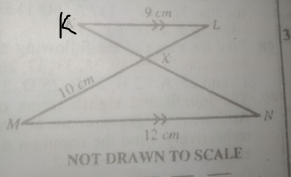
In the diagram above, \(\overline{MN} || \overline{KL}\), \(\overline{ML}\) and \(\overline{KN}\) intersect at X. |\(\overline{MN}\)| = 12cm, |\(\overline{MX}\)| = 10cm and |\(\overline{MN}\)| = 9cm. If the area of \(\triangle\) MXN is 16cm\(^2\), calculate the area of \(\triangle\) LXK
Attached Figure / Diagram
A
9cm\(^2\)
B
8cm\(^2\)
C
10cm\(^2\)
D
12cm\(^2\)
medium Difficulty
Verified Correct Answer: Option A
Step-by-Step Mathematical Solution
\(\overline{MN} || \overline{KL}\), \(\triangle\) LXK is similar to \(\triangle\)MXN
So, the ratio of the areas of the two similar triangles equals the square of the ratio of their corresponding sides
Therefore, \(\frac{ Area of \triangle MXN}{Area of \triangle LXK} = \frac{12^2}{9^2}\)
\(\frac{16}{Area of \triangle LXK} = \frac{144}{81}\)
Area of \(\triangle\)LXK = \(\frac{ 16 \times 81}{144} = 9cm^2\)
Source: WAEC / JAMB / NECO Classroom Archive (Record #71797)
Physics
WAEC / WASSCE 2024
Heat Energy & Temperature
Solution
(a)(i) What is a thermometric liquid?
(ii) State the reason for the following design features of a clinical thermometer. I. Narrow bore: II. Thin wall of the bulb
(b) Distinguish between heat and temperature of an object in terms of the energy of a particle
(c) Explain why evaporation leads to cooling
(d) A kettle rated 2000W, contains water at 20ºC. The kettle is switched on and after two minutes, the water starts boiling. After another six minutes, 45% of the water in the kettle boils away. (i) Determine the specific latent heat of the vaporization of the water (ii) State one assumption made in your calculation 9d(i) above
medium Difficulty
Verified Correct Answer: Option
Physical Principles & Numerical Solution
(a) A thermometric liquid is a liquid used in thermometers to measure temperature. It expands and contracts uniformly with changes in temperature, allowing for accurate readings.
(ii) I. Narrow Bore
Reason: Allows precise measurement by controlling the movement of the thermometric liquid, ensuring quick and accurate readings
II. Thin Wall of the Bulb
Reason: Enhances thermal conductivity, enabling faster heat transfer for quicker and more accurate temperature readings.
(b) Heat is a measure of the change in total internal energy in a body while temperature is a measure of the average kinetic energy of a molecule of the body.
(c) Evaporation leads to cooling for these reasons:
Energy Absorption: Molecules at the surface absorb energy to break free, often from the liquid and its surroundings.
Loss of High-Energy Molecules: Higher-energy molecules evaporate, reducing the average kinetic energy of the remaining liquid.
Temperature Decrease: As the average kinetic energy drops, the temperature of the liquid decreases, resulting in cooling.
(d)(i) Given: P = 2000W, \(\theta\) = 20ºC, t = 2 mins = 120 secs.
P x t = mc\(\Delta\)\(\theta\)
m = \(\frac{P \times t}{c \times \Delta \theta}\)
m = \(\frac{2000 \times 120}{4200 \times (100 - 20)}\) = 0.714 kg
Also, Pt = ml
l = \(\frac{Pt}{m}\)
where m = 45% of 0.714, t = 6mins = 360secs
l = \(\frac{2000 \times 60 \times 6}{0.714 \times 0.45}\) = 2.29 x 10\(^6\)Jkg\(^{-1}\)
(d)(i) Assumption made: there is no loss of heat to the surroundings, and the heat capacity of the material of the kettle is negligible.
Source: WAEC / JAMB / NECO Classroom Archive (Record #72092)
Physics
WAEC / WASSCE 2024
Waves & Wave Motion
Solution
The maximum displacement of particles from equilibrium position in a wave motion is known as
A
wave length.
B
amplitude.
C
frequency.
D
polarization.
medium Difficulty
Verified Correct Answer: Option B
Physical Principles & Numerical Solution
The maximum displacement of particles from equilibrium position in a wave motion is known as "amplitude".
Source: WAEC / JAMB / NECO Classroom Archive (Record #72074)
Physics
WAEC / WASSCE 2024
Satellite and Rocket
Solution
(a) State two uses of a polar satellite.
(b) What does the slope of a graph of tensile stress against tensile strain represent?
medium Difficulty
Verified Correct Answer: Option
Physical Principles & Numerical Solution
(a) The uses of polar satellites include:
(i) for location identification
(ii) to collect data on climate change
(iii) observe and predict a natural disaster
(iv) use for communication.
(b) The slope of a graph of tensile stress against tensile strain represents the modulus of elasticity, also known as Young's modulus. Young's modulus quantifies the stiffness of a material. A steeper slope indicates a stiffer material, while a flatter slope indicates a more flexible material.
Source: WAEC / JAMB / NECO Classroom Archive (Record #72085)
Physics
WAEC / WASSCE 2024
Work, Energy and Power
Solution
A body of mass, m is projected vertically upward with a velocity, y. At what position will the potential energy be maximum?
A
\(\frac{y}{g}\)
B
\(\frac{2y^2}{g}\)
C
\(\frac{y^2}{2g}\)
D
\(\frac{y^2}{4g}\)
medium Difficulty
Verified Correct Answer: Option C
Physical Principles & Numerical Solution
At the maximum height, all the kinetic energy will have been converted into potential energy:
mgh = \(\frac{1}{2}\)mv\(^2\)
v = y
gh = \(\frac{1}{2}\)y\(^2\)
h = \(\frac{y^2}{2g}\)
Thus, the potential energy will be maximum at the height given by: \(\frac{y^2}{2g}\)
Source: WAEC / JAMB / NECO Classroom Archive (Record #72057)
Physics
WAEC / WASSCE 2024
Linear Motion & Kinematics
Solution
The magnitude of the acceleration of a moving object is equal to the
A
gradient of a displacement-time graph
B
gradient of a velocity-time graph
C
area below a force-time graph
D
area below a velocity-time graph
medium Difficulty
Verified Correct Answer: Option B
Physical Principles & Numerical Solution
The magnitude of the acceleration of a moving object is equal to the rate of change of its velocity over time. Gradient of a velocity-time graph refers to the slope of the graph that plots velocity (y-axis) against time (x-axis).
Source: WAEC / JAMB / NECO Classroom Archive (Record #72008)
Physics
WAEC / WASSCE 2024
Linear Motion & Kinematics
Diagram
Solution
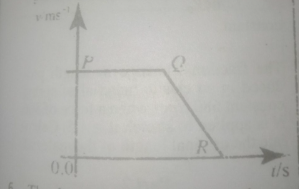
The diagram above illustrates the motion of a cyclist from P to R. The distance travelled is determined by the
Attached Figure / Diagram
A
area under QR
B
area under PQR
C
gradient of PQR
D
gradient of QR
medium Difficulty
Verified Correct Answer: Option B
Physical Principles & Numerical Solution
The total area under the entire segment from P to R (the area of the triangle plus the area of the rectangle) represents the total distance traveled by the cyclist during the motion from P to R.
Source: WAEC / JAMB / NECO Classroom Archive (Record #72022)
Physics
WAEC / WASSCE 2024
Linear Motion & Kinematics
Solution
A body moves with uniform velocity when the resultant force on it is
A
greater than the frictional force acting on it
B
less than the frictional force acting on it
C
equal to zero
D
equal to unity
medium Difficulty
Verified Correct Answer: Option C
Physical Principles & Numerical Solution
A body moves with uniform velocity when there is no acceleration. According to Newton's first law of motion, an object will remain in its state of rest or uniform motion unless acted upon by a net external force.Therefore, if the resultant force acting on the body is equal to zero, it will maintain a constant velocity, which means it can be moving at a constant speed in a straight line.
Source: WAEC / JAMB / NECO Classroom Archive (Record #72028)
Physics
WAEC / WASSCE 2024
Linear Motion & Kinematics
Diagram
Solution
The diagram above illustrates two boxes P and Q of masses 27.3 kg and 6.2 kg respectively on a smooth horizontal surface. If a force F of 150 N is applied to the combined forces, calculate the acceleration.
Attached Figure / Diagram

A
4.5 ms\(^{-2}\)
B
33.5 ms\(^{-2}\)
C
70 ms\(^{-2}\)
D
150 ms\(^{-2}\)
medium Difficulty
Verified Correct Answer: Option A
Physical Principles & Numerical Solution
Total mass of the two boxes = 27.3 + 6.2 = 33.5kg
F = ma
a = \(\frac{\text{F}}{\text{m}}\) = \(\frac{150}{33.5}\) = 4.4776... ≈ 4.5 ms\(^{-2}\)
Source: WAEC / JAMB / NECO Classroom Archive (Record #72060)
Physics
WAEC / WASSCE 2024
Equilibrium of Forces
Diagram
Solution
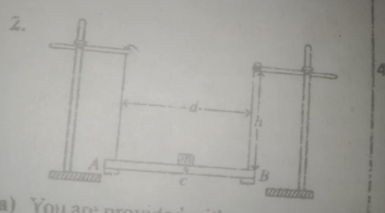
(a) You are provided with two metre rules, two retort stands, a mass, m = 100g, thread, and other necessary apparatus
(i) Place one of the metre rules on a knife edge and determine the centre of gravity, C
(ii) Measure and record the mass, M\(_R\) of the metre rule
(iii) Attach the mass = 100g firmly to the metre rule AB at C using paper tape
(iv) Suspend the metre rule by two parallel threads of length, h = 40cm each at 10 cm and 90cm mark. Ensure that the graduated face of the metre rule is facing upwards.
(v) Set the metre rule into small angular oscillation about the vertical axis through the centre of gravity.
(vi) Determine the time, t for 20 complete oscillations. Evaluate the period T and T\(^2\).
(vii) Read and record the value of d in metres.
(viii) Keeping d, constant, repeat the procedure for four other values of h = 50, 60, 70, and 80 cm. In each case, determine t and evaluate T and T\(^2\).
(ix) Tabulate the readings
(x) Plot a graph of T\(^2\) on the vertical axis and h on the horizontal.
(xi) Determine the slope, s of the graph
(xii) Evaluate K = \(\frac{\text{S}}{\text{Q}}\) where Q = \(\frac{2}{25d^2}\)
(xiii) State two precautions taken to ensure accurate results
b(i) Define couple as it relates to oscillatory motion
(ii) Give two practical applications of a couple in everyday life.
Attached Figure / Diagram
medium Difficulty
Verified Correct Answer: Option
Physical Principles & Numerical Solution
(a)i c = 50.0cm
(ii) M\(_R\) = 90.0 g
(vii) d = 0.8m
(ix)
S/N
h(cm)
t(s)
T= \(\frac{t}{20}\)s
T\(^2\)s\(^2\)
1
40.0
26.12
1.306
1.7056
2
50.0
27.80
1.390
1.9321
3
60.0
30.68
1.534
2.3532
4
70.0
34.60
1.730
2.9929
5
80.0
35.80
1.790
3.2041
(x) SEE THE GRAPH ABOVE
(xi) Slope, s = \(\frac{\DeltaT^2}{\Delta h}\) = \(\frac{3.0 - 1.75}{75 - 46}\) = \(\frac{1.25}{29}\) = 0.431s\(^2\)cm\(^{-1}\)
(xii) K = \(\frac{\text{S}}{\text{Q}}\)
where, Q = \(\frac{2}{25d^2}\) = \(\frac{2}{25 \times (0.8)^2}\) = 0.125
K = \(\frac{\text{S}}{\text{Q}}\) = \(\frac{0.431}{0.125}\) = 0.3448
b(i) A couple, as related to oscillatory motion, refers to a pair of forces that are equal in magnitude but opposite in direction, and act on opposite sides of a pivot or fulcrum, causing rotation or torsion.
b(ii) I. Wrenches: When using a wrench to tighten or loosen a bolt, the force applied creates a couple that produces rotational motion. II. Steering Wheels: Turning the steering wheel of a car applies a couple that rotates the front wheels, allowing for directional change. III. Door Handles: When pushing or pulling on one side of a door handle, a couple is created that rotates the door about its hinges. IV. Bicycle Pedals: When pedaling a bicycle, the force applied to the pedals generates a couple that turns the crankshaft, propelling the bike forward.
Source: WAEC / JAMB / NECO Classroom Archive (Record #72110)