Question Library
Browse, filter, and study verified past examination questions with step-by-step mathematical reasoning.
Searching 18,000+ Questions...
Sifting topics, KaTeX formulas & verified solutions
Showing 316–330 of 14883 verified questions
Sort by:
Physics
UTME / JAMB 2025
Mechanics and Properties of Matter
Solution
A boy uses a single string pulley system to lift a mass of 20kg moving with a velocity of 5ms\(^{-1}\). What is the power developed by the boy if g = 10ms\(^{-2}\)?
A
100W
B
1000W
C
250W
D
40W
medium Difficulty
Verified Correct Answer: Option B
Physical Principles & Numerical Solution
Answer: B. 1000W
(Fixed pulley: force = mg = 200 N; power = F \times v = 200 \times 5 = 1000 W.)
Source: Myschool Past Questions Archive (Record #74366)
Physics
UTME / JAMB 2025
Heat Energy & Temperature
Solution
When both the object and its image move together in the same direction relative to the observer, then there is
A
no parallax error
B
blurred image
C
mechanical error
D
parallax error
medium Difficulty
Verified Correct Answer: Option A
Physical Principles & Numerical Solution
Answer: A. no parallax error (No apparent shift if moving together.)
Source: Myschool Past Questions Archive (Record #74357)
Physics
UTME / JAMB 2025
Mechanics and Properties of Matter
Diagram
Solution
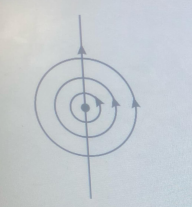
The diagram above shows a magnetic field due to a
Attached Figure / Diagram
A
solenoid
B
circular coil
C
current-carrying straight conductor
D
the earth's meridian
medium Difficulty
Verified Correct Answer: Option C
Physical Principles & Numerical Solution
Answer: C. current carrying straight conductor (Concentric circles typical of straight wire magnetic field.)
(Diagram: concentric circular field lines around a central point on a vertical line, arrows clockwise, indicating field around a wire.)
Source: Myschool Past Questions Archive (Record #74358)
Physics
UTME / JAMB 2025
Thermal Physics
Solution
Without considering the containing vessel, what mass of boiled water can raise the temperature of 8 kg of water from 25^\circC to 60^\circC when mixed in a heat-proof container?
A
10kg
B
7kg
C
5kg
D
6kg
medium Difficulty
Verified Correct Answer: Option B
Physical Principles & Numerical Solution
Answer: B. 7kg
(Heat balance: m \times 4200 \times (100 - 60) = 8 \times 4200 \times (60-25);
m = \(\frac{(8 \times 35)}{40}\) = 7 kg.)
Source: Myschool Past Questions Archive (Record #74367)
Physics
UTME / JAMB 2025
Heat Energy & Temperature
Solution
Which of the following has the least thermal conductivity?
A
air
B
ash
C
glass
D
water
medium Difficulty
Verified Correct Answer: Option A
Physical Principles & Numerical Solution
Answer: A. air
(Air is a poor conductor ~0.025 W/mK; water ~0.6, glass ~1, ash varies but is higher.)
Air is a poor conductor of heat compared to solids and liquids like ash, glass, and water, making it a good insulator.
Source: Myschool Past Questions Archive (Record #74368)
Physics
UTME / JAMB 2025
Mechanics and Properties of Matter
Solution
What form of energy is present in the food we eat?
A
Kinetic
B
Mechanical
C
Potential
D
Chemical
medium Difficulty
Verified Correct Answer: Option D
Physical Principles & Numerical Solution
Answer: D
Food stores energy in chemical bonds, released during metabolism.
Source: Myschool Past Questions Archive (Record #74378)
Physics
UTME / JAMB 2025
Mechanics and Properties of Matter
Solution
What magnitude of electric current can store 2.5 J of energy in a 3 H induction coil?
A
1.29 A
B
2.48 A
C
5.00 A
D
3.66 A
medium Difficulty
Verified Correct Answer: Option A
Physical Principles & Numerical Solution
Answer: A
Energy in an inductor: E = \(\frac{1}{2}\)LI\(^2\) ⇒ I ≈ 1.29 A.
Source: Myschool Past Questions Archive (Record #74379)
Physics
UTME / JAMB 2025
Mechanics and Properties of Matter
Solution
A machine has an efficiency of 80%. If the input work is 200J, the output work is?
A
250J
B
160J
C
120J
D
100J
medium Difficulty
Verified Correct Answer: Option B
Physical Principles & Numerical Solution
\(\text{Efficiency} = \frac{\text{Output Work}}{\text{Input Work}}\)
Given: \(\text{Efficiency} = 80\% = 0.8\), \(\text{Input Work} = 200 \text{ J}\)
Then, the output work is calculated as follows:
\(\text{Output Work} = 0.8 \times 200 = 160 \, \text{J}\)
Thus, the output work is: \(\text{Output Work} = 160 \, \text{J}\).
Source: Myschool Past Questions Archive (Record #74380)
Physics
UTME / JAMB 2025
Waves and Optics
Solution
Lining the walls of an auditorium with perforated materials reduces
A
reverberation
B
diffraction
C
refraction
D
auditorium pulse
medium Difficulty
Verified Correct Answer: Option A
Physical Principles & Numerical Solution
Answer: A
Perforated materials absorb sound, reducing reverberation.
Source: Myschool Past Questions Archive (Record #74382)
Physics
UTME / JAMB 2025
Mechanics and Properties of Matter
Solution
If an object sinks in water, it means that
A
Its density is greater than that of water
B
upthrust equals its weight
C
its density is less than that of water
D
water pressure is greater than its weight
medium Difficulty
Verified Correct Answer: Option A
Physical Principles & Numerical Solution
Answer: A
An object sinks when its density is greater than that of water.
Source: Myschool Past Questions Archive (Record #74383)
Physics
UTME / JAMB 2025
Heat Energy & Temperature
Solution
The movement of particles in liquids and gases is referred to as
A
Translational motion
B
Isobaric process
C
Brownian motion
D
Vibrational motion
medium Difficulty
Verified Correct Answer: Option C
Physical Principles & Numerical Solution
Brownian motion is the random motion of particles in fluids.
Source: Myschool Past Questions Archive (Record #74386)
Physics
UTME / JAMB 2025
Electricity and Magnetism
Solution
What mass of silver is deposited during electrolysis when a current of 0.8 A flows for 25 minutes?
A
0.22 g
B
1.86 g
C
0.14 g
D
1.34g
medium Difficulty
Verified Correct Answer: Option D
Physical Principles & Numerical Solution
Answer: D
To calculate the mass of silver deposited during electrolysis, we use the formula:
\(m = \frac{Q \cdot M}{n \cdot F}\)
Where: \( I = 0.8 \, \text{A} \), \( t = 25 \, \text{minutes} = 25 \times 60 = 1500 \, \text{s} \), \( Q = I \cdot t = 0.8 \, \text{A} \cdot 1500 \, \text{s} = 1200 \, \text{C} \)
\( M = 107.87 \, \text{g/mol} \), \( n = 1 \), \( F \approx 96485 \, \text{C/mol} \)
Substituting the values:
\(m = \frac{1200 \, \text{C} \cdot 107.87 \, \text{g/mol}}{1 \cdot 96485 \, \text{C/mol}} = \frac{129444}{96500} \approx 1.34 \, \text{g}\)
Source: Myschool Past Questions Archive (Record #74387)
Physics
UTME / JAMB 2025
Thermal Physics
Solution
The thermal capacity of a body depends on one of the following
A
Quantity of heat
B
Temperature and mass
C
Nature and mass
D
Mass, volume, and temperature
medium Difficulty
Verified Correct Answer: Option C
Physical Principles & Numerical Solution
The thermal capacity (or heat capacity) of a body is the amount of heat required to raise its temperature by 1^\circC (or 1 K). It is calculated as:
C = m.c
where:
( m ) is the mass of the body,
( c ) is the specific heat capacity, which depends on the nature (material or substance) of the body.
Thus, thermal capacity depends on both the mass and the nature of the material.
Source: Myschool Past Questions Archive (Record #74388)
Physics
UTME / JAMB 2025
Mechanics and Properties of Matter
Solution
What is the pressure exerted by 4.5m\(^3\) of gas at 17ºC in a cylinder if the number of moles is 8.3 moles? (R = 8.31 JK\(^{-1}\)mol\(^{-1}\))
A
3170Pa
B
6740Pa
C
2850Pa
D
4445Pa
medium Difficulty
Verified Correct Answer: Option D
Physical Principles & Numerical Solution
The ideal gas law is \( PV = nRT \).
Making \( P \) the subject:
\[ P = \frac{nRT}{V} \]
Substitute the values:
- \( n = 8.3 \, \mathrm{mol} \), \( R = 8.31 \, \mathrm{J \, K^{-1} \, mol^{-1}} \), \( T = 17^\circ \mathrm{C} = 290 \, \mathrm{K} \)
- \( V = 4.5 \, \mathrm{m}^3 \)
\( P = \frac{8.3 \times 8.31 \times 290}{4.5} = 4444.93 \, \mathrm{Pa} \)
Source: Myschool Past Questions Archive (Record #74432)
Physics
UTME / JAMB 2025
Mechanics and Properties of Matter
Solution
If the specific gravity of a liquid is 0.76, calculate its density((\(\rho_w\) = 1000Kgm\(^{-3}\))
A
760Kgm\(^{-3}\)
B
76Kgm\(^{-3}\)
C
7.6Kgm\(^{-3}\)
D
7600Kgm\(^{-3}\)
medium Difficulty
Verified Correct Answer: Option A
Physical Principles & Numerical Solution
Specific gravity (SG) is the ratio of the density of the liquid (\(\rho_l\)) to the density of water (\(\rho_w\)):
\( \mathrm{SG} = \frac{\rho_l}{\rho_w} \)
Rearranging for density:
\((\rho_l = \mathrm{SG} \times \rho_w = 0.76 \times 1000 = 760 \, \mathrm{kg \, m^{-3}}\)
Source: Myschool Past Questions Archive (Record #74478)