Question Library
Browse, filter, and study verified past examination questions with step-by-step mathematical reasoning.
Searching 18,000+ Questions...
Sifting topics, KaTeX formulas & verified solutions
Showing 301–315 of 14883 verified questions
Sort by:
Chemistry
UTME / JAMB 2025
Unsaturated Saturated and Supersaturated Solutions
Solution
Commercial deodorant is an example of a colloid called
A
aerosol
B
sol
C
foam
D
emulsion
medium Difficulty
Verified Correct Answer: Option A
Chemical Principles & Mechanism
The commercial deodorant (specifically spray or mist form) is an example of a colloid called an aerosol.
In this type of colloid, the dispersed phase (the substance being spread out) is a liquid, while the dispersion medium (the substance the phase is dispersed in) is a gas (air or propellant).
Source: WAEC / JAMB / NECO Classroom Archive (Record #74248)
Chemistry
UTME / JAMB 2025
Endothermic and Exothermic Reactions
Diagram
Solution
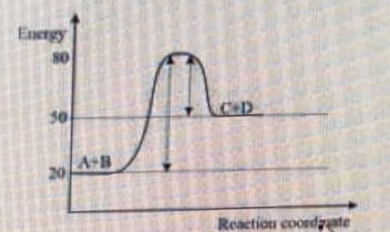
The reaction above illustrated is
Attached Figure / Diagram
A
spontaneous
B
endothermic
C
exothermic
D
reversible
medium Difficulty
Verified Correct Answer: Option B
Chemical Principles & Mechanism
In the reaction given, the chemical reaction can be re-written as A + B → C + D
This implies, A and B are the reactants, while C and D are the products.
The energy level of the products (C+D) is higher (50) on the graph than the energy level of the reactants (A+B), (20). The arrow representing the overall enthalpy change (\DeltaH) points upward, showing a gain in energy, resulting in a positive \DeltaH value.
i.e \DeltaH\(_{reaction}\) = \DeltaH\(_{product}\) - \DeltaH\(_{reactant}\)
\DeltaH\(_{reaction}\) = (C+D) - ( A+B)
= 50 - 20 = +30
\DeltaH\(_{reaction}\) = + ve , hence, it is an endothermic reaction - option B
Source: WAEC / JAMB / NECO Classroom Archive (Record #74881)
Physics
UTME / JAMB 2025
Waves and Optics
Solution
Which of these colours in the visible spectrum has the longest wavelength?
A
Red
B
Blue
C
Yellow
D
Violet
medium Difficulty
Verified Correct Answer: Option A
Physical Principles & Numerical Solution
Answer: A. Red (Visible spectrum: red ~700 nm, longest; violet ~400 nm, shortest.)
Source: Myschool Past Questions Archive (Record #74347)
Physics
UTME / JAMB 2025
Mechanics and Properties of Matter
Solution
The power of a lens in diopters is
A
3f
B
\(\frac{1}{\text{f}}\)
C
2f
D
f
medium Difficulty
Verified Correct Answer: Option B
Physical Principles & Numerical Solution
Lens power P = 1/f, where f is focal length in meters; unit is diopter.
Source: Myschool Past Questions Archive (Record #74348)
Physics
UTME / JAMB 2025
Heat Energy & Temperature
Solution
A man moves 6.0m East and then 10.0m N30ºE. How far is he from his starting point?
A
15.0m
B
17.0m
C
14.0m
D
12.0m
medium Difficulty
Verified Correct Answer: Option C
Physical Principles & Numerical Solution
The two displacements are 6.0 m East and 10.0 m at N30ºE.
The angle between East and N30ºE is 60^\circ.
Using the cosine rule:
R\(^2\) = 6\(^2\) +10\(^2\) +2(6)(10)cos60º
R\(^2\) = 36 + 100 +120 (0.5) = 196
R = \(\sqrt{196}\) = 14.0m
Source: Myschool Past Questions Archive (Record #74349)
Physics
UTME / JAMB 2025
Mechanics and Properties of Matter
Solution
The density of water is 1g/cm\(^3\) while that of ice is 0.9g/cm\(^3\). Calculate the change in volume when 90g of ice is completely melted.
A
9cm\(^3\)
B
90cm\(^3\)
C
0cm\(^3\)
D
10cm\(^3\)
medium Difficulty
Verified Correct Answer: Option D
Physical Principles & Numerical Solution
Answer: D. 10cm³
(Volume ice = \(\frac{90}{0.9}\) = 100 cm\(^3\);
volume water = \(\frac{90}{1}\) = 90 cm\(^3\);
change = 10 cm\(^3\) decrease.)
Source: Myschool Past Questions Archive (Record #74350)
Physics
UTME / JAMB 2025
Mechanics and Properties of Matter
Solution
The graphical representation of the pressure law is always a straight line passing through the origin, only if the temperature scale is
A
Rankine
B
Celsius
C
Fahrenheit
D
thermodynamic
medium Difficulty
Verified Correct Answer: Option D
Physical Principles & Numerical Solution
Answer: D. thermodynamic (Pressure law P ∝ T requires an absolute scale like Kelvin (thermodynamic) for a line through the origin at T= 0, P= 0. Rankine is also absolute but less common in this context.)
Source: Myschool Past Questions Archive (Record #74351)
Physics
UTME / JAMB 2025
Mechanics and Properties of Matter
Solution
According to the kinetic theory of gases, the pressure exerted by a gas on the walls equals.
A
Momentum imparted to the walls per unit area.
B
Change in momentum per unit volume.
C
Change in momentum imparted to the walls per unit area.
D
Rate of change of momentum imparted to the walls per second per unit area.
medium Difficulty
Verified Correct Answer: Option D
Physical Principles & Numerical Solution
D. Rate of change of momentum imparted to the walls per second per unit area. (Pressure = force/area = (rate of momentum change)/area from molecular collisions.)
Source: Myschool Past Questions Archive (Record #74352)
Physics
UTME / JAMB 2025
Waves and Optics
Solution
Which of the following is not true about a wave in a plucked string?
A
It is mechanical
B
It has a crest
C
It is transverse
D
It is longitudinal
medium Difficulty
Verified Correct Answer: Option D
Physical Principles & Numerical Solution
Answer: D.
It is longitudinal (String waves are transverse; perpendicular to propagation.
Source: Myschool Past Questions Archive (Record #74353)
Physics
UTME / JAMB 2025
Electricity and Magnetism
Solution
The emf of a cell is the potential difference across its terminals when it is in
A
series connection
B
closed circuit
C
open circuit
D
parallel connection
medium Difficulty
Verified Correct Answer: Option C
Physical Principles & Numerical Solution
Answer: C.
open circuit (EMF is maximum PD with no current drawn.
Source: Myschool Past Questions Archive (Record #74354)
Physics
UTME / JAMB 2025
Thermal Physics
Solution
The thermometric property of mercury is best on the change in
A
density with temperature
B
volume with temperature
C
pressure with temperature
D
resistance with temperature
medium Difficulty
Verified Correct Answer: Option B
Physical Principles & Numerical Solution
Answer: B.
volume with temperature (Mercury thermometers rely on thermal expansion of volume.)
Source: Myschool Past Questions Archive (Record #74355)
Physics
UTME / JAMB 2025
Waves and Optics
Solution
Some of the features of the human eye that greatly help to refract light entering the eyes are
A
cornea and lens
B
cornea and aqueous humor
C
lens and vitreous humor
D
aqueous humor and lens
medium Difficulty
Verified Correct Answer: Option A
Physical Principles & Numerical Solution
Answer: A.
cornea and lens (Main refractive structures.)
Source: Myschool Past Questions Archive (Record #74356)
Physics
UTME / JAMB 2025
Heat Energy & Temperature
Solution
The gravitational pull between two bodies is 20N. Find the gravitational pull when their distance of separation is doubled.
A
10N
B
5N
C
13N
D
20N
medium Difficulty
Verified Correct Answer: Option B
Physical Principles & Numerical Solution
Answer: B. 5N
(F ∝ \(\frac{1}{r^2}\);
doubled r → \(\frac{\text{F}}{4}\) = \(\frac{20}{4}\) = 5 N.)
Source: Myschool Past Questions Archive (Record #74363)
Physics
UTME / JAMB 2025
Thermal Physics
Solution
The volume of a 1 cm\(^3\) metal ball increases by 0.0018 cm\(^3\) when heated through temperature \theta. If the linear expansivity of the ball is 2.0 x 10\(^{-5} K^{-1}\), find \theta.
A
20°C
B
50°C
C
30°C
D
25°C
medium Difficulty
Verified Correct Answer: Option C
Physical Principles & Numerical Solution
Answer: C. 30^\circC
(Volume exp. γ = 3 \alpha = 6\times10\(^{-5}\)K\(^{-1}\);
\DeltaV = V γ \theta;
\theta = \(\frac{0.0018}{1 \times 6\times 10^{-5}}\) = 30^\circC.
Source: Myschool Past Questions Archive (Record #74364)
Physics
UTME / JAMB 2025
Mechanics and Properties of Matter
Solution
For a gas, which pair of variables is inversely proportional to each other (provided other conditions are constant), where P = pressure, T= temperature, V= volume, and n= number of molecules?
A
P, T
B
P, V
C
n, P
D
V, T
medium Difficulty
Verified Correct Answer: Option B
Physical Principles & Numerical Solution
Answer: B. P, V
(Boyle's law: P ∝ \(\frac{1}{\text{V}}\) at constant T, n.)
Source: Myschool Past Questions Archive (Record #74365)