Question Library
Browse, filter, and study verified past examination questions with step-by-step mathematical reasoning.
Searching 18,000+ Questions...
Sifting topics, KaTeX formulas & verified solutions
Showing 286–300 of 14883 verified questions
Sort by:
Physics
UTME / JAMB 2025
Reflection of Light
Solution
An annular eclipse is formed when
A
The sun, moon, and earth comes in straight line
B
One of the sun, moon, and earth are not visible
C
Two or more stars gathered together
D
The Earth comes between the moon and the sun
medium Difficulty
Verified Correct Answer: Option A
Physical Principles & Numerical Solution
Annular Eclipse: Occurs when the Sun, Moon, and Earth are aligned in a straight line, but the Moon is at a distance where it does not completely cover the Sun.
Source: WAEC / JAMB / NECO Classroom Archive (Record #74568)
Physics
UTME / JAMB 2025
Refraction of Light
Solution
I. The colour of light depends on its frequency II. When white light is dispersed by a triangular prism, yellow is deviated more than green III. Rainbows are formed when rains fall heavily. Which of the above statements is/are correct about dispersion and colours?
A
I and III only
B
I only
C
II and III only
D
I and II only
medium Difficulty
Verified Correct Answer: Option B
Physical Principles & Numerical Solution
Answer: B. I only (I true; II false, yellow deviated less than green; III false, rainbows from light refraction in drops.)
Source: WAEC / JAMB / NECO Classroom Archive (Record #74359)
Physics
UTME / JAMB 2025
Refraction of Light
Solution
If the critical angle for a glass–air boundary is 45º, what is the refractive index of the glass?
A
\(\sqrt{2}\)
B
\(\sqrt{5}\)
C
\(\sqrt{3}\)
D
2\(\sqrt{2}\)
medium Difficulty
Verified Correct Answer: Option A
Physical Principles & Numerical Solution
Answer: A
n = \(\frac{1}{\text{sinC}}\) = \(\frac{1}{sin45º}\) = \(\sqrt{2}\).
Source: WAEC / JAMB / NECO Classroom Archive (Record #74371)
Physics
UTME / JAMB 2025
Refraction of Light
Diagram
Solution
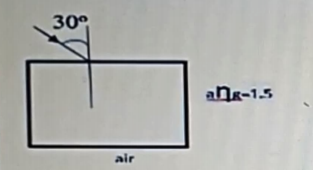
From the diagram above, the sine of the angle of refraction in glass is
Attached Figure / Diagram
A
0.4
B
0.3
C
0.2
D
0.1
medium Difficulty
Verified Correct Answer: Option B
Physical Principles & Numerical Solution
\(_ag_g\) = \(\frac{\text{sini}}{\text{sinr}}\)
sinr = \(\frac{\text{sini}}{_ag_g}\)
sinr = \(\frac{0.5}{1.5}\)
sinr = 0.3
Source: WAEC / JAMB / NECO Classroom Archive (Record #74493)
Physics
UTME / JAMB 2025
Refraction of Light
Solution
What colour has the lowest frequency in the spectrum of white light?
A
Red
B
Yellow
C
Indigo
D
Blue
medium Difficulty
Verified Correct Answer: Option A
Physical Principles & Numerical Solution
A. Red
Red light has the longest wavelength and the lowest frequency compared to the other colors listed.
ROYGBIV: arranged in increasing frequency or decreasing wavelength.
Source: WAEC / JAMB / NECO Classroom Archive (Record #74563)
Physics
UTME / JAMB 2025
Refraction of Light
Diagram
Solution
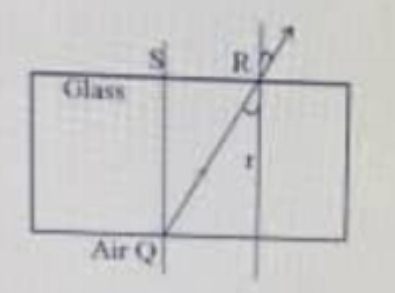
Given that SQ = 10cm and SR = 6cm, the refractive index of the block of glass shown in the above figure is
Attached Figure / Diagram
A
1.67
B
0.60
C
0.30
D
2.33
medium Difficulty
Verified Correct Answer: Option A
Physical Principles & Numerical Solution
For a ray entering and exiting parallel faces of a glass slab, the refractive index is given by:
n = \(\frac{\text{real depth}}{\text{apparent depth}}\)
Where SR = 6cm is apparent depth, SQ = 10cm real depth.
n = \(\frac{10}{6}\) = 1.6666 ≈ 1.67
Source: WAEC / JAMB / NECO Classroom Archive (Record #74660)
Physics
UTME / JAMB 2025
Waves
Solution
The distance between two successive trough points of a wave is
A
two wavelength
B
a wavelength
C
one third wavelength
D
half wavelength
medium Difficulty
Verified Correct Answer: Option B
Physical Principles & Numerical Solution
The distance between two successive troughs of a wave is equal to one wavelength (\lambda)
One wavelength (\lambda) is defined as the distance between two successive points in the same phase (crest to crest or trough to trough).
Source: WAEC / JAMB / NECO Classroom Archive (Record #74562)
Physics
UTME / JAMB 2025
Sound Wave
Solution
What happens to the speed of sound in air when the pressure increases at a constant temperature
A
Unchanged
B
Increase
C
Reduce
D
Varies
medium Difficulty
Verified Correct Answer: Option A
Physical Principles & Numerical Solution
The speed of sound in air at a constant temperature is primarily dependent on the temperature of the air rather than the pressure. At a constant temperature, changes in pressure do not significantly affect the speed of sound.
Source: WAEC / JAMB / NECO Classroom Archive (Record #74494)
Physics
UTME / JAMB 2025
Sound Wave
Solution
The speed of sound in air is 60 m/s. How far from the centre of a storm is an observer who hears a thunder clap 4s after the flash of the lightning?
A
140m
B
100m
C
340m
D
240m
medium Difficulty
Verified Correct Answer: Option D
Physical Principles & Numerical Solution
Speed of sound = 60 m/s
Time delay = 4 s (light travel time is negligible)
Distance = speed \times time = 60 \times 4 = 240 m
Source: WAEC / JAMB / NECO Classroom Archive (Record #74545)
Physics
UTME / JAMB 2025
Application of Lens
Solution
A short-sighted person's far point is 95cm. The defect can be corrected using
A
Diverging mirror of focal length 95cm
B
Plano convex lens of focal length 90cm
C
Diverging lens of focal length 95cm
D
Converging lens of focal length 95cm
medium Difficulty
Verified Correct Answer: Option C
Physical Principles & Numerical Solution
Short-sightedness (myopia) means distant objects focus in front of the retina, with the far point at 95 cm. A diverging lens (concave) corrects this by creating a virtual image of distant objects (u = \infty) at the far point (v = -95 cm). Using the lens formula: 1/f = 1/v - 1/u = -1/95 - 0, so f = -95 cm (diverging lens with focal length 95 cm).
Source: WAEC / JAMB / NECO Classroom Archive (Record #74554)
Physics
UTME / JAMB 2025
Application of Lens
Solution
The focal length of the natural eye lens is variable due to the action of the
A
Optical fluid
B
Ciliary muscle
C
Vitreous humor
D
retina nerves
medium Difficulty
Verified Correct Answer: Option B
Physical Principles & Numerical Solution
B. Ciliary muscle.
The ciliary muscles control the shape of the lens, allowing the eye to focus on objects at different distances by changing the focal length of the lens.
Source: WAEC / JAMB / NECO Classroom Archive (Record #74567)
Physics
UTME / JAMB 2025
Fundamental and Derived Quantities
Solution
The dimensional symbol of tension in a string is expressed as
A
L T\(^{-2}\)
B
M\(^2\) L\(^{-1}\) T\(^{-2}\)
C
M L T\(^2\)
D
M L T\(^{-2}\)
medium Difficulty
Verified Correct Answer: Option D
Physical Principles & Numerical Solution
The tension \( T \) in a string is defined as the force acting along the string. The dimensional formula for force is given by:
\([T] = [F] = [M^1 L^1 T^{-2}]\)
Thus, the dimensional symbol of tension in a string is:
\([T] = [M L T^{-2}]\)
Source: WAEC / JAMB / NECO Classroom Archive (Record #74488)
Physics
UTME / JAMB 2025
Electrical Conduction Through Liquids and Gases
Solution
Copper of 0.2g and silver of 1.2g are deposited when current is passed through copper and silver voltameter. Calculate the electrochemical equivalent, Z of silver if that of copper is 0.00028gC\(^{-1}\)
A
1.68 x 10\(^{-3}\)gC\(^{-1}\)
B
2.34 x 10\(^{-3}\)gC\(^{-1}\)
C
2.80 x 10\(^{-3}\)gC\(^{-1}\)
D
3.34 x 10\(^{-3}\)gC\(^{-1}\)
medium Difficulty
Verified Correct Answer: Option A
Physical Principles & Numerical Solution
From Faraday's first law, the mass deposited \( m = Z Q \), where \( Z \) is the electrochemical equivalent and \( Q \) is the charge passed.
Since the same charge \( Q \) passes through both voltmeters:
\(Q = \frac{m_{\mathrm{Cu}}}{Z_{\mathrm{Cu}}} = \frac{m_{\mathrm{Ag}}}{Z_{\mathrm{Ag}}} \)
Rearranging for \( Z_{\mathrm{Ag}} \):
\(Z_{\mathrm{Ag}} = \frac{m_{\mathrm{Ag}} \cdot Z_{\mathrm{Cu}}}{m_{\mathrm{Cu}}} \)
But: \( m_{\mathrm{Cu}} = 0.2 \, \mathrm{g} \), \( m_{\mathrm{Ag}} = 1.2 \, \mathrm{g} \), \( Z_{\mathrm{Cu}} = 0.00028 \, \mathrm{g \, C^{-1}} \)
\(Z_{\mathrm{Ag}} = \frac{1.2 \times 0.00028}{0.2} = \frac{0.000336}{0.2} = 0.00168 \, \mathrm{g \, C^{-1}} \)
Source: WAEC / JAMB / NECO Classroom Archive (Record #74479)
Chemistry
UTME / JAMB 2025
Atomic Structure and Bonding
Solution
Atom with the electron configuration of 1S\(^2\)2S\(^2\)2P\(^6\)3S\(^2\) belongs to
A
Group 3 and Period 2
B
Group 8 and Period 3
C
Group 2 and Period 3
D
Group 2 and Period 6
medium Difficulty
Verified Correct Answer: Option C
Chemical Principles & Mechanism
Magnesium (Mg) belongs to Group 2 (the Alkaline Earth metals) and Period 3 of the periodic table, meaning it has 2 valence electrons and three electron shells, placing it in the s-block.
Source: WAEC / JAMB / NECO Classroom Archive (Record #74220)
Chemistry
UTME / JAMB 2025
Chemical Bonding
Solution
The type of bond between copper(II) tetraamine and chlorine in [Cu(NH\(_3\))\(_4\)]Cl\(_2\)
A
dative
B
van der waals
C
ionic
D
covalent
medium Difficulty
Verified Correct Answer: Option C
Chemical Principles & Mechanism
The compound [Cu(NH\(_3\))\(_4\)]Cl\(_2\) is an ionic compound composed of a complex cation, the tetraamminecopper(II) ion ([Cu(NH\(_3\))\(_4\)]\(^{2+}\)), and two chloride anions (Cl\(^−\)).
The primary force connecting the positively charged complex ion and the negatively charged chloride ions is the electrostatic attraction known as an ionic bond. This bond forms between species with a significant difference in electronegativity, specifically between a cation and an anion.
Dative bonds (coordinate covalent bonds) exist within the complex ion itself, specifically between the central copper(II) ion and the nitrogen atoms of the ammonia ligands.
Van der Waals forces and typical covalent bonds are not the main attractive forces between the distinct cation and anion units in this solid salt structure.
The correct answer is ionic - option C
Source: WAEC / JAMB / NECO Classroom Archive (Record #74137)