Question Library
Browse, filter, and study verified past examination questions with step-by-step mathematical reasoning.
Searching 18,000+ Questions...
Sifting topics, KaTeX formulas & verified solutions
Showing 271–285 of 14883 verified questions
Sort by:
Physics
UTME / JAMB 2025
Electric Field
Solution
When capacitors are connected in series across a potential difference, there is a loss in their stored energy because:
A
Increase in the internal resistance of the voltage
B
Unequal charges being deposited on the capacitors
C
a charge flows between the capacitors
D
decrease in the overall capacitance of the capacitors
medium Difficulty
Verified Correct Answer: Option D
Physical Principles & Numerical Solution
When capacitors are connected in series across a potential difference, there is a loss in their stored energy primarily due to the decrease in overall capacitance, which limits the amount of energy they can store, rather than due to charge flowing between the capacitors.
Source: WAEC / JAMB / NECO Classroom Archive (Record #74565)
Physics
UTME / JAMB 2025
Current Electricity
Solution
Which of the following is better for measuring a very small resistance?
A
Voltmeter
B
Wheatstone bridge
C
rheostat
D
Potentiometer
medium Difficulty
Verified Correct Answer: Option B
Physical Principles & Numerical Solution
A Wheatstone bridge is specifically designed for the accurate measurement of small and unknown resistances. It operates on the principle of balancing two legs of a bridge circuit, enabling precise determination of resistance values.
Potentiometer: Used to measure potential difference or electromotive force (emf), not to measure resistance directly.
Rheostat: A variable resistor utilized to control current, rather than for measuring resistance.
Wheatstone Bridge: The most effective method for measuring very small resistances.
Source: WAEC / JAMB / NECO Classroom Archive (Record #74484)
Physics
UTME / JAMB 2025
Current Electricity
Solution
What is the electrolyte used in wet Leclanche cell
A
Nickle hydroxide
B
Lead dioxide
C
Ammonium chloride
D
Carbon
medium Difficulty
Verified Correct Answer: Option C
Physical Principles & Numerical Solution
C. Ammonium chloride.
It is the electrolyte in the wet Leclanché cell (aqueous solution).Others:
Nickel hydroxide: In Ni-Cd/Ni-MH batteries.
Lead dioxide: Cathode in lead-acid batteries.
Carbon: Conductivity enhancer, not electrolyte.
Source: WAEC / JAMB / NECO Classroom Archive (Record #74558)
Physics
UTME / JAMB 2025
Current Electricity
Diagram
Solution
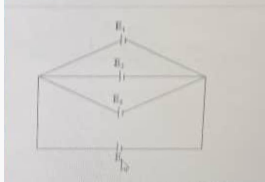
Assuming E\(_1\), E\(_2\), and E\(_3\), are equal, then the total e.m.f of the arrangement will be given by
Attached Figure / Diagram
A
\(\frac{1}{\text{E}}\) = (\(\frac{1}{E_1}\) +\(\frac{1}{E_2}\)) + E\(_3\)
B
E = \(E_1\) + \(E_2\) + \(E_3\)
C
\(\frac{1}{\text{E}}\) = \(\frac{1}{E_1}\) + \(\frac{1}{E_2}\) + \(\frac{1}{E_3}\)
D
E = \(E_1\) = \(E_2\) = \(E_3\)
medium Difficulty
Verified Correct Answer: Option D
Physical Principles & Numerical Solution
Parallel connection does not add the voltages; it only increases the current capacity. Thus, total e.m.f. E = E\(_1\) = E\(_2\) = E\(_3\).
Source: WAEC / JAMB / NECO Classroom Archive (Record #74659)
Physics
UTME / JAMB 2025
Energy and Power
Solution
A 500W electric oven plugged into a 220 V source will consume an electric current of
A
4.88A
B
2.27A
C
6.43A
D
3.23A
medium Difficulty
Verified Correct Answer: Option B
Physical Principles & Numerical Solution
Answer: B. 2.27A
(I = \(\frac{\text{P}}{\text{V}}\) = \(\frac{500}{220}\) ≈ 2.27 A.)
Source: WAEC / JAMB / NECO Classroom Archive (Record #74361)
Physics
UTME / JAMB 2025
Energy and Power
Solution
A refrigerator uses 150W. If it is kept on for 336 hours nonstop. What is the energy consumed in Kwh?
A
60.20Kwh
B
25.01Kwh
C
50.40Kwh
D
30.20Kwh
medium Difficulty
Verified Correct Answer: Option C
Physical Principles & Numerical Solution
C. 50.40Kwh
Convert power to kW (150 W = 0.15 kW), then multiply by time in hours: energy = 0.15 kW \times 336 h = 50.4 kWh.
Source: WAEC / JAMB / NECO Classroom Archive (Record #74555)
Physics
UTME / JAMB 2025
Energy and Power
Diagram
Solution
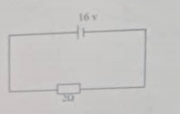
The electrical power developed in the resistor above is
Attached Figure / Diagram
A
8W
B
64W
C
128W
D
256W
medium Difficulty
Verified Correct Answer: Option C
Physical Principles & Numerical Solution
The circuit is a simple series circuit with a 16 V battery (or voltage source) directly connected across a 2 \Omega resistor.
The power (\(P\)) dissipated (developed) in the resistor is given by: \(P = \frac{V^2}{R}\)
where \(V = 16 \, \text{V}\) and \(R = 2 \, \Omega\).
Calculating the power: \(P = \frac{16^2}{2} = \frac{256}{2} = 128 \, \text{W}\)
Source: WAEC / JAMB / NECO Classroom Archive (Record #74679)
Physics
UTME / JAMB 2025
Simple Ac Circuit
Solution
In an A.C circuit, the instantaneous current is 7A. What is the root mean square(r.m.s) value of the current I\(_{r.m.s}\)
A
5A
B
6A
C
3A
D
4A
medium Difficulty
Verified Correct Answer: Option A
Physical Principles & Numerical Solution
For an A.C. current,
\(I_{\text{r.m.s}} = \frac{I_0}{\sqrt{2}}\)
where (I_0) is the maximum (peak) current.
Given (I_0 = 7,\text{A}),
\(I_{\text{r.m.s}} = \frac{7}{\sqrt{2}} \approx 4.95,\text{A}\)
Answer: \(4.95 \text{A}\ \ (\approx 5\ \text{A})\)
Source: WAEC / JAMB / NECO Classroom Archive (Record #74485)
Physics
UTME / JAMB 2025
Simple Ac Circuit
Diagram
Solution
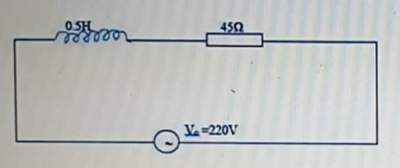
From the above circuit, calculate the impedance ((\(\pi\) = \(\frac{22}{7}\), f = 50Hz)
Attached Figure / Diagram
A
86.7\(\Omega\)
B
163.5\(\Omega\)
C
204.8\(\Omega\)
D
16.3\(\Omega\)
medium Difficulty
Verified Correct Answer: Option B
Physical Principles & Numerical Solution
Given: Inductance: \( L = 0.5 \, \text{H} \), Resistance: \( R = 45 \, \Omega \), Frequency: \( f = 50 \, \text{Hz} \)
inductive reactance \( X_L \): \(X_L = 2 \pi f L = 2 \times \frac{22}{7} \times 50 \times 0.5 = \frac{1100}{7} \approx 157.14 \, \Omega\)
The impedance \( Z \):
\(Z = \sqrt{R^2 + X_L^2} = \sqrt{(45)^2 + (157.14)^2} = \sqrt{2025 + 24642.82} \approx \sqrt{26667.82} \approx 163.5 \, \Omega\).
Source: WAEC / JAMB / NECO Classroom Archive (Record #74489)
Physics
UTME / JAMB 2025
Semi Conductor
Solution
Charge carriers in doped semiconductors are
A
electrons and protons
B
electrons and neutrons
C
anions and cations
D
electrons and holes
medium Difficulty
Verified Correct Answer: Option D
Physical Principles & Numerical Solution
Electrical conduction in semiconductors occurs via electrons and holes.
Source: WAEC / JAMB / NECO Classroom Archive (Record #74370)
Physics
UTME / JAMB 2025
Structure of the Nucleus
Solution
Calculate the decay constant of a radioactive isotope of half-life 138.5 s.
A
5.0 × 10\(^{-3}\) s\(^{-1}\)
B
5.1 × 10\(^{-3}\) s\(^{-1}\)
C
4.9 × 10\(^{-3}\) s\(^{-1}\)
D
5.2 × 10\(^{-3}\) s\(^{-1}\)
medium Difficulty
Verified Correct Answer: Option A
Physical Principles & Numerical Solution
Answer: A
\lambda = \(\frac{ln2}{T½ }\) ⇒ \(\frac{0.693}{138.5}\) ≈ 5.0 \times 10\(^{-3}\) s\(^{-1}\).
Source: WAEC / JAMB / NECO Classroom Archive (Record #74374)
Physics
UTME / JAMB 2025
Structure of the Nucleus
Solution
One of the following is not a radiation detector
A
Electrophorus
B
Scintillation chamber
C
Geiger muller counter
D
Film badge
medium Difficulty
Verified Correct Answer: Option A
Physical Principles & Numerical Solution
A. Electrophorus. It generates static electricity via induction and is not a radiation detector. The others are:
Scintillation chamber: Detects radiation via light flashes.
Geiger-Muller counter: A gas-filled detector for ionizing radiation.
Film badge: Records cumulative radiation exposure on photographic film.
Source: WAEC / JAMB / NECO Classroom Archive (Record #74557)
Physics
UTME / JAMB 2025
Reflection of Light
Solution
A concave mirror of focal length 20cm produces an erect image that is four times the object, the object distance from the mirror is
A
less than 20cm
B
Between 20cm and30cm
C
Between 30cm and 40cm
D
Greater than 40cm
medium Difficulty
Verified Correct Answer: Option A
Physical Principles & Numerical Solution
A. Less than 20 cm
For a concave mirror, an erect image is virtual (behind the mirror) and forms when the object is placed between the pole and focus (\( u < f \)).
Magnification:
\(m = +4 \quad (\text{erect, so positive})\)
Using the mirror formula:
\(\frac{1}{v} + \frac{1}{u} = \frac{1}{f}\)
Given \( f = -20 \, \text{cm} \) (concave), \( u \) is negative.
Since \( m = -\frac{v}{u} \):
\(v = -m u = -(+4)u = -4u\)
Substituting into the mirror formula:
\(\frac{1}{-4u} + \frac{1}{u} = \frac{1}{-20}\)
Combining the fractions:
\(\frac{3}{4u} = \frac{1}{-20}\)
Thus, solving for \( u \):
\(3 \cdot -20 = 4u \quad \Rightarrow \quad u = -15 \, \text{cm}\)
Object distance \( |u| = 15 \, \text{cm} < 20 \, \text{cm} \).
Thus, it is less than 20 cm.
OR
A concave mirror only gives an erect, magnified image when the object is placed between the mirror and its focal point. Since the focal length is 20 cm, the object must be closer than 20 cm to the mirror.
Source: WAEC / JAMB / NECO Classroom Archive (Record #74541)
Physics
UTME / JAMB 2025
Reflection of Light
Solution
A 25cm long pinhole camera produces a one-fifth of an object's size. Calculate the object distance
A
20.49m
B
2.82m
C
4.23m
D
1.25m
medium Difficulty
Verified Correct Answer: Option D
Physical Principles & Numerical Solution
D. 1.25 m
In a pinhole camera, the relationship between image size and object size is given by:
\(\frac{\text{Image Size}}{\text{Object Size}} = \frac{v}{u}\)
where \( v \) is the camera length. Given \( v = 25 \, \text{cm} = 0.25 \, \text{m} \).
The image is one-fifth the object size, so the magnification is:
\(\text{Magnification} = \frac{1}{5} = \frac{v}{u}\)
Thus, we can rearrange this to find \( u \):
\(u = 5v = 5 \times 0.25 = 1.25 \, \text{m}\).
Source: WAEC / JAMB / NECO Classroom Archive (Record #74547)
Physics
UTME / JAMB 2025
Reflection of Light
Solution
If 10 objects, tinsels are placed between the mirror of a Kaleidoscope with an inclination of 30º, how many images are formed?
A
110
B
181
C
142
D
210
medium Difficulty
Verified Correct Answer: Option A
Physical Principles & Numerical Solution
In a kaleidoscope (two plane mirrors inclined at an angle ( \theta )):
\(\text{Number of images of one object} = \frac{360^\circ}{\theta} - 1\)
Given: \(\theta = 30^\circ\)
\(\frac{360}{30}\) = 12
So, images formed by one object: 12 - 1 = 11
For 10 objects (tinsels):
10 x 11 = 110 images formed.
Source: WAEC / JAMB / NECO Classroom Archive (Record #74564)