Question Library
Browse, filter, and study verified past examination questions with step-by-step mathematical reasoning.
Searching 18,000+ Questions...
Sifting topics, KaTeX formulas & verified solutions
Showing 256–270 of 14883 verified questions
Sort by:
Physics
UTME / JAMB 2025
Scalars and Vectors
Diagram
Solution
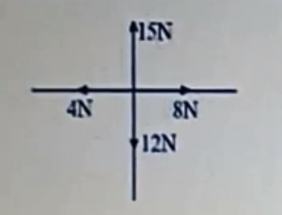
The resultant of the force shown above is
Attached Figure / Diagram
A
18.00N
B
5.00N
C
10.20N
D
3.15N
medium Difficulty
Verified Correct Answer: Option B
Physical Principles & Numerical Solution
Net force in the horizontal (x) direction:
\(F_x = 8 \, \text{N} - 4 \, \text{N} = 4 \, \text{N} \quad \text{(to the right)}\)
Net force in the vertical (y) direction:
\(F_y = 15 \, \text{N} - 12 \, \text{N} = 3 \, \text{N} \quad \text{(3 N upward)}\)
Magnitude of the resultant force: \(R = \sqrt{F_x^2 + F_y^2} = \sqrt{(4)^2 + (3)^2} = \sqrt{16 + 9} = \sqrt{25} = 5 \, \text{N}\)
Source: WAEC / JAMB / NECO Classroom Archive (Record #74542)
Physics
UTME / JAMB 2025
Heat and Temperature
Solution
The volume of a fixed mass of gas at 0º C is 200 m\(^3\). What is its volume at 273º C at constant pressure?
A
100 m\(^3\)
B
400 m\(^3\)
C
800 m\(^3\)
D
200 m\(^3\)
medium Difficulty
Verified Correct Answer: Option B
Physical Principles & Numerical Solution
At constant pressure, volume ∝ absolute temperature (Charles’ law).
\(\frac{V_1}{T_1} = \frac{V_2}{T_2}\)
\(\frac{200}{273} = \frac{V_2}{546}\)
v\(_2\) = \(\frac{200 \times 546}{273}\) = 400cm\(^3\)
Source: WAEC / JAMB / NECO Classroom Archive (Record #74372)
Physics
UTME / JAMB 2025
Heat and Temperature
Solution
What pressure would a 5000N weight of water exert at the bottom of a reservoir containing it if its length and breadth are 10m and 5m, respectively
A
200Pa
B
182Pa
C
100Pa
D
120Pa
medium Difficulty
Verified Correct Answer: Option C
Physical Principles & Numerical Solution
The pressure exerted by the water at the bottom of the reservoir is given by:
\(P = \frac{F}{A}\)
Given: \( F = 5000 \, \text{N} \) (weight of water), \( L = 10 \, \text{m} \) (length), \( B = 5 \, \text{m} \) (breadth)
Calculate the area \( A \):
\(A = L \times B = 10 \, \text{m} \times 5 \, \text{m} = 50 \, \text{m}^2\)
Calculate the pressure \( P \):
\(P = \frac{F}{A} = \frac{5000 \, \text{N}}{50 \, \text{m}^2} = 100 \, \text{Pa}\)
Source: WAEC / JAMB / NECO Classroom Archive (Record #74490)
Physics
UTME / JAMB 2025
Heat and Temperature
Solution
Which of the following thermometer types best responds to a change in temperature
A
Mercury thermometer
B
Resistance thermometer
C
Gas thermometer
D
Alcohol thermometer
medium Difficulty
Verified Correct Answer: Option B
Physical Principles & Numerical Solution
Resistance thermometers respond faster because they have small sensor mass and use direct electrical detection. Liquid-in-glass and gas thermometers are slower due to thermal expansion and larger thermal inertia, often taking minutes to equilibrate.
Source: WAEC / JAMB / NECO Classroom Archive (Record #74546)
Physics
UTME / JAMB 2025
Heat and Temperature
Solution
A gas is cooled at a constant pressure from 57ºC was observed to shrink one-fifth (1\5) of its original volume of 2.00cm\(^3\). Find its new temperature
A
-150\(^o\)C
B
-207\(^0\)C
C
-195\(^0\)C
D
-200\(^0\)C
medium Difficulty
Verified Correct Answer: Option B
Physical Principles & Numerical Solution
Using Charles' law:
\(\frac{V_1}{T_1} = \frac{V_2}{T_2} \quad \text{(T in Kelvin, constant P)}\)
Calculate \( T_1 \): \(T_1 = 57 + 273 = 330 \, \text{K}\)
Since \( V_2 = \frac{1}{5} V_1 \) (volume shrinks to one-fifth), we find \( T_2 \):
\(T_2 = T_1 \times \frac{V_2}{V_1} = 330 \times \frac{1}{5} = 66 \, \text{K}\)
In ^\circC, this is: \(T_2 = 66 - 273 = -207 \, ^\circC\)
Source: WAEC / JAMB / NECO Classroom Archive (Record #74572)
Physics
UTME / JAMB 2025
Heat Transfer
Solution
A well-lagged thin metal rod of length 0.2 m has a temperature gradient of 416 K m\(^{-1}\). If one end is at 233º C, what is the temperature at the other end?
A
141.20°C
B
257.48°C
C
408.60°C
D
316.28°C
medium Difficulty
Verified Correct Answer: Option D
Physical Principles & Numerical Solution
Answer: D
Given a rod of length \( L = 0.2 \, \text{m} \) with a temperature gradient of \( 416 \, \text{K/m} \) and one end at \( T_1 = 233^\circ \text{C} \):
\(\Delta T = \text{gradient} \times L = 416 \, \text{K/m} \times 0.2 \, \text{m} = 83.2 \, \text{K}\)
The temperature at the other end \( T_2 \) is:
\(T_2 = T_1 + \Delta T = 233^\circ \text{C} + 83.2 \, \text{C} = 316.2^\circ \text{C}\)
Thus, the temperature at the other end is \( 316.2^\circ \text{C}\).
Source: WAEC / JAMB / NECO Classroom Archive (Record #74384)
Physics
UTME / JAMB 2025
Evaporation and Boiling
Solution
A collection of condensed suspended dust particles in the air constitute
A
Cloud
B
fog
C
Mist
D
Rain
medium Difficulty
Verified Correct Answer: Option B
Physical Principles & Numerical Solution
Clouds are collections of condensed water droplets or ice crystals suspended in the air, but high above the ground (typically hundreds of meters to kilometers up).
Fog is the same phenomenon (condensed suspended droplets, often with dust), but at ground level, reducing visibility.
The question specifies "in the air" near the surface (implied by dust particles and suspension context), so fog is correct, not cloud.
Source: WAEC / JAMB / NECO Classroom Archive (Record #74551)
Physics
UTME / JAMB 2025
Gravitational Field
Solution
If the weight of an object on the Earth's surface is 2.5 x 10\(^3\)N, what is its weight on the moon's surface if the gravitational force of the moon is one-sixth of the Earth's(g = 10m/s\(^{-2}\))
A
360.87N
B
416.67N
C
214.49N
D
510.79N
medium Difficulty
Verified Correct Answer: Option B
Physical Principles & Numerical Solution
Weight on Earth:
\(W_e = 2.5 \times 10^3 \, \text{N}, \quad g_e = 10 \, \text{m/s}^2\)
Mass: \(m = \frac{W_e}{g_e} = \frac{2500}{10} = 250 \, \text{kg}\)
Moon's gravity is approximately \( \frac{1}{6} \) of Earth's:
\(g_m = \frac{10}{6} \, \text{m/s}^2\)
Weight on the Moon: \(W_m = m \times g_m = 250 \times \frac{10}{6} = \frac{2500}{6} \approx 416.67 \, \text{N}\)
Thus, the weight on the Moon is: 416.67N
Source: WAEC / JAMB / NECO Classroom Archive (Record #74570)
Physics
UTME / JAMB 2025
Gravitational Field
Solution
The gravitational force between two masses, P and Q, is 10N, find the new value of the force if both masses are doubled
A
40.0N
B
20.0N
C
10.0N
D
2.5N
medium Difficulty
Verified Correct Answer: Option A
Physical Principles & Numerical Solution
The gravitational force \( F \) between two masses is given by Newton's law of universal gravitation:
\(F = G \frac{m_1 m_2}{r^2}\)
where \( G \) is the gravitational constant, \( m_1 \) and \( m_2 \) are the masses (P and Q), and \( r \) is the distance between their centers.
Originally, \( F = 10 \, \text{N} \).
If both masses are doubled (\( m_1' = 2P \), \( m_2' = 2Q \)) and \( r \) remains constant, the new force is:
\(F' = G \frac{(2P)(2Q)}{r^2} = G \frac{4PQ}{r^2} = 4 \left( G \frac{PQ}{r^2} \right) = 4 \times 10 = 40 \, \text{N}\)
Source: WAEC / JAMB / NECO Classroom Archive (Record #74573)
Physics
UTME / JAMB 2025
Electric Field
Diagram
Solution
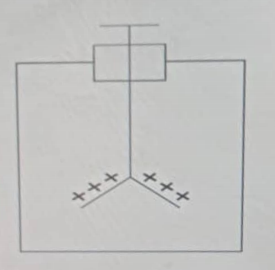
If a positively charged rod is brought close to the cap in the diagram above, the divergence
Attached Figure / Diagram
A
is unchanged
B
Increases
C
decreases
D
Collapses
medium Difficulty
Verified Correct Answer: Option B
Physical Principles & Numerical Solution
B. Increases
When a positively charged rod is brought near the cap of a positively charged gold-leaf electroscope (as indicated by the diverging leaves with + signs in the diagram), electrostatic induction occurs. The rod attracts negative charges toward the cap and repels additional positive charges toward the leaves. This increases the positive charge on the leaves, enhancing their mutual repulsion and thus increasing the divergence.
Source: WAEC / JAMB / NECO Classroom Archive (Record #74569)
Physics
UTME / JAMB 2025
Magnetic Field
Solution
The point where no magnetic effect is felt around a magnet is
A
near point
B
far point
C
Infinite point
D
Neutral point
medium Difficulty
Verified Correct Answer: Option D
Physical Principles & Numerical Solution
The neutral point around a magnet is where the magnetic field strength is zero, meaning no magnetic effects (like deflection of a compass needle) are observed, often due to cancellation by Earth's magnetic field.
Source: WAEC / JAMB / NECO Classroom Archive (Record #74477)
Physics
UTME / JAMB 2025
Magnetic Field
Solution
The commonly used materials for shielding or screening magnetism is
A
Alumumium
B
Brass
C
Soft iron
D
Copper
medium Difficulty
Verified Correct Answer: Option C
Physical Principles & Numerical Solution
Soft iron has high magnetic permeability, so it easily attracts and redirects magnetic field lines, shielding areas from external magnetic fields. Aluminum, brass, and copper do not have this property and are ineffective for magnetic shielding.
Source: WAEC / JAMB / NECO Classroom Archive (Record #74556)
Physics
UTME / JAMB 2025
Magnetic Field
Solution
A method of demagnetization is
A
placing the magnetic bar in a solenoid
B
double-stroking the magnet with soft in n-s direction
C
heating a magnetic bar red hot and allowed to cool e-w direction
D
hammering the magnetic bar repeatedly in n-s direction
medium Difficulty
Verified Correct Answer: Option C
Physical Principles & Numerical Solution
This process disrupts the alignment of magnetic domains, effectively demagnetizing the bar.
Source: WAEC / JAMB / NECO Classroom Archive (Record #74662)
Physics
UTME / JAMB 2025
Electromagnetic Field
Solution
The device that operates using the magnetic effect of electric current is
A
Rheostat
B
Thermostat
C
Electric bell
D
Carbon microphone
medium Difficulty
Verified Correct Answer: Option C
Physical Principles & Numerical Solution
Answer: C
An electric bell works using an electromagnet.
Source: WAEC / JAMB / NECO Classroom Archive (Record #74373)
Physics
UTME / JAMB 2025
Electric Field
Solution
A circular parallel plate capacitor with radius 6cm is separated by 0.12cm. Calculate the capacitance of the capacitor [\(\pi\) = 3.142, ε\(_0\) = 8.85 x 10\(^{-12}\)Nm\(^2\)C\(^2\)]
A
4.3 x 10\(^{-11}\)F
B
5.1 x 10\(^{11}\)F
C
8.3 x 10\(^{-11}\)F
D
9.6 x 10\(^{-11}\)F
medium Difficulty
Verified Correct Answer: Option C
Physical Principles & Numerical Solution
The capacitance \( C \) of a parallel-plate capacitor is calculated using the formula:
\(C = \epsilon_0 \frac{A}{d}\)
where: \(\epsilon_0 = 8.85 \times 10^{-12} \, \text{F/m},\)
\(A = \pi r^2 \quad \text{(area of one plate)},\)
and \( d \) is the separation between plates. \(r = 6 \, \text{cm} = 0.06 \, \text{m},\)
\(d = 0.12 \, \text{cm} = 0.0012 \, \text{m}\)
Calculate the area: \(A = \pi r^2 = 3.142 \times (0.06)^2 = 3.142 \times 0.0036 = 0.0113112 \, \text{m}^2\)
Calculate the capacitance: \(C = 8.85 \times 10^{-12} \times \frac{0.0113112}{0.0012} = 8.85 \times 10^{-12} \times 9426 \approx 8.34 \times 10^{-11} \, \text{F}\)
Source: WAEC / JAMB / NECO Classroom Archive (Record #74543)