Question Library
Browse, filter, and study verified past examination questions with step-by-step mathematical reasoning.
Searching 18,000+ Questions...
Sifting topics, KaTeX formulas & verified solutions
Showing 241–255 of 14883 verified questions
Sort by:
Physics
UTME / JAMB 2025
Waves & Wave Motion
Solution
Which of the following electromagnetic spectra has the shortest wavelength?
A
Ultra violet radiation
B
X - rays
C
Visible light
D
Infrared
medium Difficulty
Verified Correct Answer: Option B
Physical Principles & Numerical Solution
The general ordering of the electromagnetic spectrum from shortest to longest wavelength is as follows:
1. Gamma rays
2. X-rays
3. Ultraviolet (UV) rays
4. Visible light
5. Infrared (IR) radiation
6. Microwaves
7. Radio waves
Therefore, X-rays are the correct answer.
Source: WAEC / JAMB / NECO Classroom Archive (Record #74481)
Physics
UTME / JAMB 2025
Waves & Wave Motion
Solution
Standing waves are produced by
A
Waves that vibrate in a vertical plane(standing upright)
B
The motion of the source toward the observer
C
The motion of the source away from the observer
D
waves that reflect off a boundary and interfere with themselves
medium Difficulty
Verified Correct Answer: Option D
Physical Principles & Numerical Solution
Standing waves are formed when waves reflect back from a boundary and interfere with the incoming waves of the same frequency and amplitude, creating points that appear to stand still (nodes) and points of maximum oscillation (antinodes).
Source: WAEC / JAMB / NECO Classroom Archive (Record #74491)
Physics
UTME / JAMB 2025
Waves & Wave Motion
Solution
Water waves and light waves differ generally in their
A
ability to be diffracted
B
ability to be reflected
C
direction of vibration
D
medium of propagation
medium Difficulty
Verified Correct Answer: Option D
Physical Principles & Numerical Solution
Water waves are mechanical waves that require a material medium, such as water, to propagate. They involve the vibration of water particles.
In contrast, light waves are electromagnetic waves that do not need a medium for propagation; they can travel through a vacuum. For example, sunlight travels through space without the need for any material medium.
Source: WAEC / JAMB / NECO Classroom Archive (Record #74661)
Physics
UTME / JAMB 2025
Simple Machine
Solution
A hydraulic press consists of two cylinders of cross-sectional radius r\(_1\) and r\(_2\). If a force of 200N applied to the smaller piston (r\(_1\)), causes a force of 3200N to be transmitted onto the larger piston (r\(_2\)). The ratio r\(_1\): r\(_2\) is?
A
1:4
B
1:2
C
1:8
D
1:16
medium Difficulty
Verified Correct Answer: Option A
Physical Principles & Numerical Solution
Answer: A. 1:4
(Pressure equal: \(\frac{F_1}{(\pi r_1^2)}\) = \(\frac{F_2}{(\pi r_2^2)}\);
\(\frac{_r2}{r_1}\) = \(\sqrt{(F_2}{F_1)}\) = \(\sqrt{16}\) = 4.)
Source: WAEC / JAMB / NECO Classroom Archive (Record #74362)
Physics
UTME / JAMB 2025
Equilibrium of Forces
Diagram
Solution
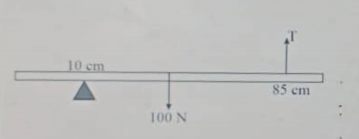
The figure shows a uniform metre rule of weight 100 N balanced by a knife edge at the 10 cm mark and a cord attached at the 85 cm mark. What is the tension in the string?
Attached Figure / Diagram
A
23.62 N
B
53.33 N
C
35.74 N
D
78.68 N
medium Difficulty
Verified Correct Answer: Option B
Physical Principles & Numerical Solution
Answer: B
For equilibrium, clockwise moment = anticlockwise moment about the pivot.
clockwise distance from pivot: 50cm - 10cm = 40cm
anticlockwise distance from pivot: 85cm - 10cm = 75cm
Applying the principle of moments
W x distance(w) = T x distance(T)
100 x 40 = T x 75
T = \(\frac{ 4000}{75}\) ≈ 53.33N
Source: WAEC / JAMB / NECO Classroom Archive (Record #74377)
Physics
UTME / JAMB 2025
Equilibrium of Forces
Diagram
Solution
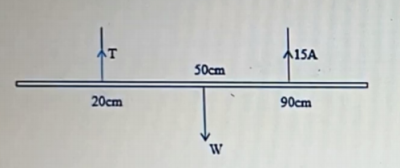
From the above figure, a uniform meter rule is suspended by two cords from a height. Calculate T?
Attached Figure / Diagram
A
11.25N
B
14.8N
C
19.24N
D
16.77N
medium Difficulty
Verified Correct Answer: Option C
Physical Principles & Numerical Solution
T x 80 + 15 x 10 = W x 50
80T + 150 = 50W - - -- - - - - -(1)
T + 15 = W - - - - - - - - - - - (2)
80T + 150 = 50(T + 15)
80T + 150 = 50T + 750
30T = 750 - 150
30T = 600
T = 20N
The closest option is 19.2N
Source: WAEC / JAMB / NECO Classroom Archive (Record #74492)
Physics
UTME / JAMB 2025
Momentum Impulse Newtons Law of Motion
Solution
A body is moving initially at 4m/s. If it's impulse after accelerating at 5m/s\(^2\) for 2s is 60Kgms\(^{-1}\). What is its mass?
A
3Kg
B
4Kg
C
6Kg
D
5Kg
medium Difficulty
Verified Correct Answer: Option C
Physical Principles & Numerical Solution
C. 6 kg
Initial velocity \( u = 4 \, \text{m/s} \), Acceleration \( a = 5 \, \text{m/s}^2 \), Time \( t = 2 \, \text{s} \)
Final velocity: \(v = u + at = 4 + 5 \times 2 = 14 \, \text{m/s}\)
Change in momentum (impulse):
\(\Delta p = m(v - u) = 60\)
Substituting for \( v \): \(m(14 - 4) = 60\)
Simplifying: \(m \times 10 = 60\)
Thus, \(m = 6 \, \text{kg}\)
Source: WAEC / JAMB / NECO Classroom Archive (Record #74552)
Physics
UTME / JAMB 2025
Simple Harmonic Motion
Diagram
Solution
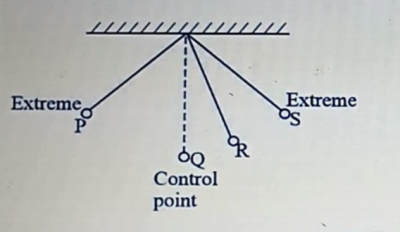
Using the oscillating simple pendulum above, the maximum kinetic energy is obtained at
Attached Figure / Diagram
A
Q
B
S
C
R
D
P
medium Difficulty
Verified Correct Answer: Option A
Physical Principles & Numerical Solution
A. Q
In a simple pendulum, kinetic energy is maximum at the lowest point (equilibrium position) where potential energy is minimum and speed is maximum.Here, Q is the control point (mean/equilibrium position), so maximum kinetic energy occurs at Q. At extremes P and S, kinetic energy is zero (velocity = 0). At R, it is between the extreme and the equilibrium.
Source: WAEC / JAMB / NECO Classroom Archive (Record #74550)
Physics
UTME / JAMB 2025
Simple Harmonic Motion
Solution
If the length of a simple pendulum is 120cm, calculate its frequency [\(\pi\) = \(\frac{22}{7}\) g = 10ms\(^{-2}\)]
A
2.8Hz
B
1.2Hz
C
12Hz
D
0.5Hz
medium Difficulty
Verified Correct Answer: Option D
Physical Principles & Numerical Solution
The frequency \( f \) of a simple pendulum is:
\(f = \frac{1}{2\pi} \sqrt{\frac{g}{L}} \quad \text{where } L = 1.2 \, \text{m}, \, g = 10 \, \text{m/s}^2, \, \pi \approx \frac{22}{7}\)
Calculate:
\(\frac{g}{L} = \frac{10}{1.2} = \frac{25}{3}, \quad \sqrt{\frac{25}{3}} = \frac{5}{\sqrt{3}}\)
\(f = \frac{1}{2 \times \frac{22}{7}} \times \frac{5}{\sqrt{3}} = \frac{35}{44\sqrt{3}}\)
Approximating \( \sqrt{3} \approx 1.732 \):
\(44 \times 1.732 \approx 76.208 \quad \Rightarrow \quad \frac{35}{76.208} \approx 0.459 \, \text{Hz}\)
Thus, the answer is \( D. \, 0.5 \) Hz.
Source: WAEC / JAMB / NECO Classroom Archive (Record #74574)
Physics
UTME / JAMB 2025
Friction
Solution
A Force 18 N pulls a 40 kg mass on a horizontal floor at 0.3 ms\(^{-2}\). Find the coefficient of friction.
A
0.003
B
0.015
C
0.300
D
0.600
medium Difficulty
Verified Correct Answer: Option B
Physical Principles & Numerical Solution
Answer: B. 0.015
(Net F = ma = 40\times0.3 = 12 N;
friction = 18 - 12 = 6 N;
\mu = \(\frac{\text{friction}}{\text{mg}}\) = \(\frac{6}{(40\times10)}\) = 0.015.)
Source: WAEC / JAMB / NECO Classroom Archive (Record #74360)
Physics
UTME / JAMB 2025
Friction
Solution
The tangential force acting on an object that opposes it from sliding freely on the adjacent surface is called
A
Weight
B
Upthrust
C
Frictional force
D
Normal force
medium Difficulty
Verified Correct Answer: Option C
Physical Principles & Numerical Solution
Frictional force is the tangential force opposing an object's free sliding on an adjacent surface. It originates from surface irregularities and intermolecular attractions between materials, resisting relative motion or its initiation.
Source: WAEC / JAMB / NECO Classroom Archive (Record #74476)
Physics
UTME / JAMB 2025
Friction
Solution
A block with an initial speed of 10 m/s slides on a horizontal surface and comes to rest after traveling a distance of 25 m. What is the coefficient of kinetic friction between the block and the surface? (Take g = 9.8 m/s\(^2\)).
A
0.1
B
0.3
C
0.2
D
0.5
medium Difficulty
Verified Correct Answer: Option C
Physical Principles & Numerical Solution
Given: g = 9.8 m/s\(^2\), a = 10 m/s, v = 0( come to rest), s = 25m
v\(^2\) = u\(^2\) + 2as
- 100 = 2 x 25 x a
a = \(\frac{-100}{50}\) = - 2 deceleration is caused by kinetic friction
But, \(\mu\) = \(\frac{\text{f}}{\text{R}}\) = \(\frac{\text{ma}}{\text{mg}}\) = \(\frac{-2}{9.8}\) ≈ 0.2.
Source: WAEC / JAMB / NECO Classroom Archive (Record #75421)
Physics
UTME / JAMB 2025
Simple Structure of Matter
Diagram
Solution
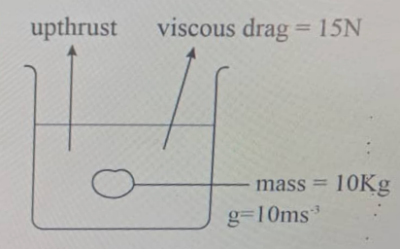
The acceleration of the body given above ( upthrust = 10N)
Attached Figure / Diagram
A
10.0m/s\(^2\)
B
20.0m/s\(^2\)
C
7.5m/s\(^2\)
D
6.8m/s\(^2\)
medium Difficulty
Verified Correct Answer: Option C
Physical Principles & Numerical Solution
The net force (\(F_{\text{net}}\)) is the weight (\(W\)) minus the total upward forces (upthrust (\(U\)) and viscous drag (\(F_{\text{drag}}\))), and this net force causes the acceleration (\(a\)) according to Newton's second law (\(F_{\text{net}}=ma\)):
\(F_{\text{net}} = W - U - F_{\text{drag}}\)
\(ma = (m \times g) - U - F_{\text{drag}}\)
\((10\text{ kg}) \times a = (10\text{ kg} \times 10\text{ m/s}^{2}) - 10\text{ N} - 15\text{ N}\)
\(10a = 100\text{ N} - 25\text{ N}\)
\(10a = 75\text{ N}\)
\(a = \frac{75\text{ N}}{10\text{ kg}}\)
\(a = 7.5\text{ m/s}^{2}\).
Source: WAEC / JAMB / NECO Classroom Archive (Record #74561)
Physics
UTME / JAMB 2025
Density and Relative Density
Solution
A wooden block of relative density 0.4 floats in a liquid of density 1600 kg m\(^{-3}\). What fraction of its volume is immersed?
A
0.15
B
0.10
C
0.25
D
0.20
medium Difficulty
Verified Correct Answer: Option C
Physical Principles & Numerical Solution
Answer: C
Fraction immersed = \(\frac{\text{density of block}}{\text{density of liquid}}\) = \(\frac{400}{1600}\) = 0.25.
Source: WAEC / JAMB / NECO Classroom Archive (Record #74381)
Physics
UTME / JAMB 2025
Deformation of Solids
Solution
When a spiral spring is compressed by an external force of 200 N, it stores 0.16 J of energy. What amount of energy will it store when compressed by an external force of 700 N?
A
1.12J
B
0.48J
C
1.96J
D
O.84J
medium Difficulty
Verified Correct Answer: Option C
Physical Principles & Numerical Solution
The elastic potential energy \( E \) is proportional to the square of the force:
\(E \propto F^2\)
(for the same spring).
The relationship between the energies for different forces is given by:
\(\frac{E_2}{E_1} = \left( \frac{F_2}{F_1} \right)^2\)
Now, substituting the known values:
\(E_2 = 0.16 \times \left( \frac{700}{200} \right)^2 = 0.16 \times (3.5)^2 = 0.16 \times 12.25 = 1.96 \, \text{J}\)
Source: WAEC / JAMB / NECO Classroom Archive (Record #74686)