Question Library
Browse, filter, and study verified past examination questions with step-by-step mathematical reasoning.
Searching 18,000+ Questions...
Sifting topics, KaTeX formulas & verified solutions
Showing 211–225 of 14883 verified questions
Sort by:
Mathematics
UTME / JAMB 2025
Matrices and Determinants
Solution
Find the sum of the entries in the inverse of \(\begin{bmatrix} 1 & 2 \\ 3 & 5 \end{bmatrix}\)
A
1
B
-1
C
2
D
0.5
medium Difficulty
Verified Correct Answer: Option B
Step-by-Step Mathematical Solution
Let the matrix be \(A = \begin{bmatrix} 1 & 2 \\ 3 & 5 \end{bmatrix}\)
The determinant of \(A\) is calculated as follows:
\(\text{Determinant} = 1 \cdot 5 - 2 \cdot 3 = 5 - 6 = -1\)
To find the inverse of \(A\), we first determine the adjoint matrix:
\(\text{Adjoint} = \begin{bmatrix} 5 & -2 \\ -3 & 1 \end{bmatrix}\)
The inverse is given by
\(A^{-1} = \frac{1}{\text{Determinant}} \cdot \text{Adjoint} = \frac{1}{-1} \begin{bmatrix} 5 & -2 \\ -3 & 1 \end{bmatrix} = \begin{bmatrix} -5 & 2 \\ 3 & -1 \end{bmatrix}\)
Next, we calculate the sum of the elements in the inverse matrix:
\(\text{Sum} = -5 + 2 + 3 + (-1) = -1\)
Source: WAEC / JAMB / NECO Classroom Archive (Record #74102)
Mathematics
UTME / JAMB 2025
Matrices and Determinants
Solution
If I is a 2 × 2 identity matrix, find the determinant of the matrix.
A
1
B
2
C
-1
D
0
medium Difficulty
Verified Correct Answer: Option A
Step-by-Step Mathematical Solution
The 2\times2 identity matrix is \(I_2 = \begin{pmatrix} 1 & 0 \\0 & 1 \end{pmatrix}\)
Determinant = (1)(1) - (0)(0) = 1.
Source: WAEC / JAMB / NECO Classroom Archive (Record #74152)
Mathematics
UTME / JAMB 2025
Matrices and Determinants
Solution
The determinant of the matrix \(A = \begin{pmatrix} -2 & 3 & 1 \\ p & 2 & 1 \\ 1 & 4 & 2\end{pmatrix}\) is -5. Find the value of p.
A
0
B
2
C
3
D
1
medium Difficulty
Verified Correct Answer: Option C
Step-by-Step Mathematical Solution
Given the matrix \(A = \begin{pmatrix} -2 & 3 & 1 \\ p & 2 & 1 \\ 1 & 4 & 2 \end{pmatrix}\) the determinant is set to \(-5\):
\(\text{det}(A) = -2 \begin{vmatrix} 2 & 1 \\ 4 & 2 \end{vmatrix} - 3 \begin{vmatrix} p & 1 \\ 1 & 2 \end{vmatrix} + 1 \begin{vmatrix} p & 2 \\ 1 & 4 \end{vmatrix}\)
Calculating the \(2 \times 2\) determinants:
1. \( \begin{vmatrix} 2 & 1 \\ 4 & 2 \end{vmatrix} = 0 \)
2. \( \begin{vmatrix} p & 1 \\ 1 & 2 \end{vmatrix} = 2p - 1 \)
3. \( \begin{vmatrix} p & 2 \\ 1 & 4 \end{vmatrix} = 4p - 2 \)
So, \(\text{det}(A) = -3(2p - 1) + (4p - 2) = -6p + 3 + 4p - 2 = -2p + 1\)
Setting this equal to \(-5\): \(-2p + 1 = -5\)
Solving for \( p \): \(-2p = -6 \implies p = 3\)
Thus, the value of \( p \) is 3
Source: WAEC / JAMB / NECO Classroom Archive (Record #74153)
Mathematics
UTME / JAMB 2025
Matrices and Determinants
Solution
Given that \(P = \begin{pmatrix} 1 & 3 \\ 2 & -5 \end{pmatrix}\) and Q = \(\begin{pmatrix} 3 & -7 \\ 1 & 2 \end{pmatrix}\) . Find P + 2Q
A
\(\begin{pmatrix} 7 & -11 \\ 4 & -1 \end{pmatrix}\)
B
\(\begin{pmatrix} 7 & -11 \\ 4 & -9 \end{pmatrix}\)
C
\(\begin{pmatrix} -7 & 11 \\ -4 & -1 \end{pmatrix}\)
D
\(\begin{pmatrix}11 & -7 \\ 4 & -1 \end{pmatrix}\)
medium Difficulty
Verified Correct Answer: Option A
Step-by-Step Mathematical Solution
Given \(P = \begin{pmatrix} 1 & 3 \\ 2 & -5 \end{pmatrix}, \quad Q = \begin{pmatrix} 3 & -7 \\ 1 & 2 \end{pmatrix}\)
we need to find \(P + 2Q\).
First, calculate \(2Q\): \(2Q = 2 \begin{pmatrix} 3 & -7 \\ 1 & 2 \end{pmatrix} = \begin{pmatrix} 2 \cdot 3 & 2 \cdot -7 \\ 2 \cdot 1 & 2 \cdot 2 \end{pmatrix} = \begin{pmatrix} 6 & -14 \\ 2 & 4 \end{pmatrix}\)
Now add \(P\) and \(2Q\):
\(P + 2Q = \begin{pmatrix} 1 & 3 \\ 2 & -5 \end{pmatrix} + \begin{pmatrix} 6 & -14 \\ 2 & 4 \end{pmatrix} = \begin{pmatrix} 1 + 6 & 3 + (-14) \\ 2 + 2 & -5 + 4 \end{pmatrix}\)
Calculating each entry, we find:
\(= \begin{pmatrix} 7 & -11 \\ 4 & -1 \end{pmatrix}\)
Thus, the result of \(P + 2Q\) is \(\begin{pmatrix} 7 & -11 \\ 4 & -1 \end{pmatrix}\)
Source: WAEC / JAMB / NECO Classroom Archive (Record #74196)
Mathematics
UTME / JAMB 2025
Financial Arithmetic
Solution
A car dealer bought a used car for ₦270,000 and spent ₦70,000 to refurbish it. He later sold the car for ₦490,000. What was the percentage profit?
A
30%
B
35%
C
25%
D
45%
medium Difficulty
Verified Correct Answer: Option D
Step-by-Step Mathematical Solution
Total cost = 270,000 + 70,000 = 340,000.
Profit = 490,000 - 340,000 = 150,000.
Percentage profit = (\(\frac{150,000}{340,000}\)) \times 100
= (\(\frac{15}{34}\)) \times 100 ≈ 44.12%. The closest option is 45%
Source: WAEC / JAMB / NECO Classroom Archive (Record #74156)
Mathematics
UTME / JAMB 2025
Financial Arithmetic
Solution
An amount of # 600,000.00 was realized when a principal y was saved for 5% simple interest for 4 years, find the value of y
A
# 570,000
B
# 500,000
C
# 300,000
D
# 400,000
medium Difficulty
Verified Correct Answer: Option B
Step-by-Step Mathematical Solution
Using \(A = P(1 + rt)\)
Substituting known values:
\(600,000 = y \left(1 + 0.05 \times 4\right)\)
\(600,000 = y \times 1.20\)
Solving for \( y \):
\(y = \frac{600,000}{1.20} = 500,000\)
Thus, the principal amount is # 500,000
Source: WAEC / JAMB / NECO Classroom Archive (Record #74170)
Mathematics
UTME / JAMB 2025
Variations
Solution
Y is partly constant and partly varies as x. When x = 3, y = 7 and when x = 5, y = 11. Find the constants of variation.
A
2,3
B
1,2
C
3,2
D
3,4
medium Difficulty
Verified Correct Answer: Option B
Step-by-Step Mathematical Solution
Form: y = a + b x.
7 = a + 3b. - - - - - - - 1
11 = a + 5b. - - - - - - 2
Solve both equations using the elimination method
Subtract: 4 = 2b ⇒ b = 2.
put b = 2 into eqn 1
a + 6 = 7 ⇒ a = 1. Constants a = 1 (constant part), b = 2 (variation constant).
Source: WAEC / JAMB / NECO Classroom Archive (Record #74100)
Mathematics
UTME / JAMB 2025
Variations
Solution
A varies directly as b\(^2\) when A = 4, b = 1. Find A when b = 2
A
12
B
14
C
16
D
11
medium Difficulty
Verified Correct Answer: Option C
Step-by-Step Mathematical Solution
A ∝ b\(^2\) so A = k b\(^2\).
Substitute: 4 = k · 1\(^2\),
k = 4.
When b = 2,
A = 4 · 4 = 16.
Source: WAEC / JAMB / NECO Classroom Archive (Record #74151)
Mathematics
UTME / JAMB 2025
Variations
Solution
P is partly constant and varies partly as Q. If P = 32 when Q = 16 and P = 20 when Q = 12, find P when Q = 28
A
68
B
64
C
66
D
62
medium Difficulty
Verified Correct Answer: Option A
Step-by-Step Mathematical Solution
The statement "P is partly constant and varies partly as Q" means P consists of a constant term plus a term directly proportional to Q. Thus, the relationship is:
P = a + bQ, where a is the constant part and b is the constant of proportionality.
Given:
P = 32 when Q = 16 → a + 16b = 32
P = 20 when Q = 12 → a + 12b = 20
Subtract the second equation from the first:
(a + 16b) - (a + 12b) = 32 - 20
4b = 12
b = 3
Substitute b = 3 into the second equation:
a + 12(3) = 20
a + 36 = 20
a = -16
Thus, P = -16 + 3Q
When Q = 28: P = -16 + 3(28) = -16 + 84 = 68
Source: WAEC / JAMB / NECO Classroom Archive (Record #74186)
Mathematics
UTME / JAMB 2025
Linear Inequalities
Solution
Solve the inequality 2x + 3 > 5x + 8
A
x > 1\(\frac{2}{3}\)
B
x > -1\(\frac{2}{3}\)
C
x < -1\(\frac{2}{3}\)
D
x < 1\(\frac{2}{3}\)
medium Difficulty
Verified Correct Answer: Option C
Step-by-Step Mathematical Solution
Given: 2x + 3 > 5x + 8
2x + 3 - 5x - 8 > 0
⇒ -3x - 5 > 0 ⇒ -3x > 5
⇒ x < \(\frac{-5}{3}\) = -1 \(\frac{2}{3}\) (inequality reverses on dividing by)
x < -1\(\frac{2}{3}\)
Source: WAEC / JAMB / NECO Classroom Archive (Record #74093)
Mathematics
UTME / JAMB 2025
Progressions (AP & GP)
Solution
Given the progression 3, 5, 7, 9,.... . . . find an expression for the (n - 2)\(^{th}\) term of the progression.
A
\(2n - 1\)
B
\(2n + 1\)
C
\(2n + 3\)
D
\(2n - 3\)
medium Difficulty
Verified Correct Answer: Option D
Step-by-Step Mathematical Solution
The sequence 3, 5, 7, 9, ... is an arithmetic progression with:
- First term \(a_1 = 3\)
- Common difference \(d = 2\)
General \(k^{th}\) term:
\(a_k = 3 + (k-1) \cdot 2 = 2k + 1\)
For the \((n-2)^{th}\) term, substitute \(k = n-2\):
\(a_{n-2} = 2(n-2) + 1 = 2n - 4 + 1 = 2n - 3\)
The expression is \(2n - 3\)
Source: WAEC / JAMB / NECO Classroom Archive (Record #74172)
Mathematics
UTME / JAMB 2025
Binary Operations
Solution
A binary operation * is defined on the set X = {1, 2, 3, 4, 5, 6} as a*b = ab + a + b. Compute 1 * 3
A
14
B
4
C
7
D
5
medium Difficulty
Verified Correct Answer: Option C
Step-by-Step Mathematical Solution
To compute 1 * 3 using the given binary operation * where a * b = ab + a + b:
Substitute a = 1 and b = 3 into the formula:
1 * 3 = (1)(3) + 1 + 3 = 3 + 1 + 3 = 7.
Thus, 1 * 3 = 7.
Source: WAEC / JAMB / NECO Classroom Archive (Record #74200)
Mathematics
UTME / JAMB 2025
Triangles and Polygons
Solution
Calculate the interior angle of a 5 - sided regular polygon
A
120º
B
90º
C
108º
D
180º
medium Difficulty
Verified Correct Answer: Option C
Step-by-Step Mathematical Solution
To calculate the interior angle of a regular polygon, we use the formula:
\(\text{Interior Angle} = \frac{(n - 2) \times 180^\circ}{n}\)
where \( n \) is the number of sides. For a 5-sided polygon (pentagon):
\(\text{Interior Angle} = \frac{(5 - 2) \times 180^\circ}{5} = \frac{3 \times 180^\circ}{5} = \frac{540^\circ}{5} = 108^\circ\)
Thus, the interior angle of a regular pentagon is \( 108^\circ \).
Source: WAEC / JAMB / NECO Classroom Archive (Record #74159)
Mathematics
UTME / JAMB 2025
Triangles and Polygons
Diagram
Solution
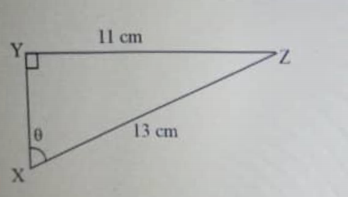
Given the triangle XYZ above, calculate the value of Cot \(\theta\) and the length XY, respectively
Attached Figure / Diagram
A
\(\frac{\sqrt{48}}{13}\), \(\sqrt{48}\)
B
\(\frac{\sqrt{48}}{11}\), \(\sqrt{48}\)
C
\(\frac{\sqrt{13}}{11}\), \(\sqrt{13}\)
D
\(\frac{13}{\sqrt{48}}\), \(\sqrt{48}\)
medium Difficulty
Verified Correct Answer: Option B
Step-by-Step Mathematical Solution
The triangle XYZ is a right-angled triangle at Y, with opposite side to \theta (YZ) = 11 cm and hypotenuse (XZ) = 13 cm.
The length of XY = \(\sqrt{(13^2 - 11^2)}\) = \(\sqrt{(169 - 121)}\) = \(\sqrt{48}\) cm (or 4\(\sqrt{3}\) cm in simplified form).
Cot \theta = \(\frac{\text{adjacent}}{\text{opposite}}\) = \(\frac{\text{XY}}{\text{YZ}}\) = \(\frac{\sqrt{48}}{11}\)
Source: WAEC / JAMB / NECO Classroom Archive (Record #74203)
Mathematics
UTME / JAMB 2025
Geometric Construction
Solution
Which of the following angles cannot be constructed using a protractor, a compass, and a sharpened pencil?
A
135°
B
90°
C
145°
D
60°
medium Difficulty
Verified Correct Answer: Option C
Step-by-Step Mathematical Solution
In classical constructions with compass and straightedge, 60^\circ (equilateral), 90^\circ (square), and 135^\circ (90^\circ + 45^\circ) are constructible. 145^\circ is not constructible in general (not a multiple resulting from bisections of constructible angles).
Source: WAEC / JAMB / NECO Classroom Archive (Record #74098)