Question Library
Browse, filter, and study verified past examination questions with step-by-step mathematical reasoning.
Searching 18,000+ Questions...
Sifting topics, KaTeX formulas & verified solutions
Showing 196–210 of 14883 verified questions
Sort by:
Biology
UTME / JAMB 2026
Science of Living Things
Solution
Which of the following is the correct base pairing on the DNA strand?
A
Guanine-Thymine
B
Cytosine-Adenine
C
Adenine-Thymine
D
Guanine-Adenine
medium Difficulty
Verified Correct Answer: Option C
Biological Concept & Syllabus Guide
In a DNA strand, the nitrogenous bases follow strict complementary rules known as Chargaff's rules:
Adenine (A) always pairs with Thymine (T) (connected by two hydrogen bonds).
Guanine (G) always pairs with Cytosine (C) (connected by three hydrogen bonds)
You can use the Acronym: A T , G C.
Source: Myschool Past Questions Archive (Record #78250)
Biology
UTME / JAMB 2026
Science of Living Things
Solution
In mammalian female reproductive system, fertilization occurs in the
A
uterus
B
ovary
C
vagina
D
oviduct
medium Difficulty
Verified Correct Answer: Option D
Biological Concept & Syllabus Guide
The oviduct (also commonly known as the fallopian tube) is the specific site for fertilization because of its location(meeting point for sperm and egg) as well as providing the exact chemical and nutrient-rich environment needed to keep both the egg and sperm alive and healthy for those crucial hours.
The uterus is where the fertilized egg implants and develops into a foetus.
The ovaries produce and release the eggs (ova) and hormones, but fertilization does not happen inside them.
The vagina receives the sperm during intercourse, acting as the entry point to the reproductive tract.
Source: Myschool Past Questions Archive (Record #78244)
Biology
UTME / JAMB 2026
Science of Living Things
Solution
Studying the homologous structures and their functions in different vertebrates to support evolution is evidence from
A
comparative anatomy
B
vestigial organs
C
cytology
D
physiology
medium Difficulty
Verified Correct Answer: Option A
Biological Concept & Syllabus Guide
Comparative anatomy is the branch of biology that involves studying and comparing the structural body plans of different species to determine their evolutionary relationships. It is the study of the similarities and differences in the body structures of different species.
Homologous structures (such as the pentadactyl limbs of vertebrates like humans, whales, bats, and birds) share a common basic skeletal architecture inherited from a shared ancestor, even though they have adapted to perform different functions.
Source: Myschool Past Questions Archive (Record #78245)
Biology
UTME / JAMB 2026
Science of Living Things
Solution
An example of homologous structures is
A
the forelimbs of whales, bat and humans
B
the eyes of humans and insects
C
the wings of birds and bats
D
the fins of fish and the wings of birds
medium Difficulty
Verified Correct Answer: Option A
Biological Concept & Syllabus Guide
Examples of homologous structures include the pentadactyl limbs of vertebrates like humans, whales, bats, and birds.
Homologous structures are body parts in different species that share a similar anatomical structure and a common evolutionary ancestor, even though they may serve completely different functions.
The forelimbs of whales, bats, and humans all share the same basic skeletal pattern (consisting of the humerus, radius, ulna, carpals, and phalanges).
Source: Myschool Past Questions Archive (Record #78246)
Biology
UTME / JAMB 2026
Science of Living Things
Solution
A typical canine consists of
A
head, crown and root
B
crown, neck and head
C
head, neck and root
D
crown, root and neck
medium Difficulty
Verified Correct Answer: Option D
Biological Concept & Syllabus Guide
Anatomically, a typical tooth (including a canine) is divided into three main parts:
Crown: The visible part of the tooth that sits above the gum line.
Root: The part embedded in the jawbone that anchors the tooth.
Neck: The slight constriction where the crown meets the root, right at the gum line.
Source: Myschool Past Questions Archive (Record #78247)
Mathematics
UTME / JAMB 2025
Algebra
Solution
Solve the simultaneous equation \(\frac{\text{x}}{2}\) - \(\frac{\text{y}}{5}\) = 1 and y - \(\frac{\text{x}}{3}\) = 8
A
x = 10, y = -6
B
x = 10, y = 6
C
x = 6, y = 10
D
x = 10, y = 6
medium Difficulty
Verified Correct Answer: Option C
Step-by-Step Mathematical Solution
\(\frac{\text{x}}{2}\) - \(\frac{\text{y}}{5}\) = 1 - - - - - - 1
y - \(\frac{\text{x}}{3}\) = 8 - - - - - 2
We clear the fractions by multiplying through by the lcm of 2 and 5 = 10 for eqn 1 and 3 for eqn 2
5x - 2y = 10 - - - - - - - 3
3y - x = 24 - - - - - - - - - 4
from eqn 4, make x the subject of formula
x = 3y - 24 (after multiply thru by -1, so x can be positive)
Put x = 3y - 24 into eqn 3
5(3y - 24) - 2y = 10
15y - 120 - 2y = 10
15y - 2y = 10 + 120
13y = 130
y = \(\frac{130}{13}\) = 10
y = 10 put in eqn 4
3y - x = 24 - - - - - - - - - 4
3(10) - x = 24
30 - x = 24
- x = 24 - 30 = -6
x = 6 ( minus cancels out minus)
Therefore, x = 6, y = 10.
Source: WAEC / JAMB / NECO Classroom Archive (Record #74092)
Mathematics
UTME / JAMB 2025
Geometry and Trigonometry
Solution
The chord of a circle of radius 17 cm is 30 cm long. Calculate the distance of the chord from the centre of the circle.
A
15cm
B
47cm
C
8cm
D
169cm
medium Difficulty
Verified Correct Answer: Option C
Step-by-Step Mathematical Solution
The distance d from the center to the chord is found using the Pythagorean theorem, where half the chord is 15 cm (\(\frac{30}{2}\)).
So d \(\sqrt{(r^2 - (\frac{chord}{2})^2}\) = \(\sqrt{(17^2 - 15^2)}\) = \(\sqrt{(289 - 225)}\) = \(\sqrt{64}\) = 8 cm.
Source: WAEC / JAMB / NECO Classroom Archive (Record #74167)
Mathematics
UTME / JAMB 2025
Number Bases
Solution
Convert 137 to base 5
A
\( 1022_5 \)
B
\( 2102_5 \).
C
\( 2210_5 \).
D
\( 2201_5 \).
medium Difficulty
Verified Correct Answer: Option A
Step-by-Step Mathematical Solution
Divide \( 137 \) by \( 5 \):
\(137 \div 5 = 27 \quad \text{(remainder } 2\text{)}\)
Divide \( 27 \) by \( 5 \):
\(27 \div 5 = 5 \quad \text{(remainder } 2\text{)}\)
Divide \( 5 \) by \( 5 \):
\(5 \div 5 = 1 \quad \text{(remainder } 0\text{)}\)
Divide \( 1 \) by \( 5 \):
\(1 \div 5 = 0 \quad \text{(remainder } 1\text{)}\)
Now, we collect the remainders in reverse order: \( 1, 0, 2, 2 \).
Thus, \( 137 \) in base \( 5 \) is represented as \( 1022_5 \).
Source: WAEC / JAMB / NECO Classroom Archive (Record #74185)
Mathematics
UTME / JAMB 2025
Indices
Solution
Find the value of t for which (\(\frac{1}{2}\))\(^{t - 1}\) = 64
A
-6
B
-5
C
-7
D
-4
medium Difficulty
Verified Correct Answer: Option B
Step-by-Step Mathematical Solution
\(\left(\frac{1}{2}\right)^{t - 1} = 64,\)
rewrite \(64\) as a power of \(\frac{1}{2}\):
\(64 = \left(\frac{1}{2}\right)^{-6}.\)
Equate the exponents: \(t - 1 = -6\)
Thus, \(t = -5\)
Source: WAEC / JAMB / NECO Classroom Archive (Record #74189)
Mathematics
UTME / JAMB 2025
Logarithms
Solution
Simplify - log\(_{10}\) 0.00001.
A
-5
B
-4
C
5
D
4
medium Difficulty
Verified Correct Answer: Option C
Step-by-Step Mathematical Solution
0.00001 = 10\(^{-5}\),
so, log\(_{10}\)(10\(^{-5}\)) = - 5.
Then -(-5) = 5.
Source: WAEC / JAMB / NECO Classroom Archive (Record #74163)
Mathematics
UTME / JAMB 2025
Surds
Solution
Solve for y in \(\sqrt{75}\) - \(\sqrt{12}\) + \(\sqrt{27}\) = y\(\sqrt{3}\)
A
\(4\sqrt{3}\)
B
\(5\sqrt{3}\)
C
\(3\sqrt{3}\)
D
\(6\sqrt{3}\)
medium Difficulty
Verified Correct Answer: Option D
Step-by-Step Mathematical Solution
\(\sqrt{75} - \sqrt{12} + \sqrt{27} = y\sqrt{3}\)
Simplify each term:
- \(\sqrt{75} = \sqrt{25 \times 3} = 5\sqrt{3}\)
- \(\sqrt{12} = \sqrt{4 \times 3} = 2\sqrt{3}\)
- \(\sqrt{27} = \sqrt{9 \times 3} = 3\sqrt{3}\)
Substitute: \(5\sqrt{3} - 2\sqrt{3} + 3\sqrt{3} = y\sqrt{3}\)
Combine like terms: \((5 - 2 + 3)\sqrt{3} = y\sqrt{3}\)
\(6\sqrt{3} = y\sqrt{3}\)
Thus, y = 6
Source: WAEC / JAMB / NECO Classroom Archive (Record #74194)
Mathematics
UTME / JAMB 2025
Number and Numeration
Solution
Express \(\sqrt[4]{0.16}\) in standard form
A
2 \(\times 10^{-\frac{1}{2}}\)
B
2 \(\times 10^2\)
C
2 \(\times 10^{-2}\)
D
2 \(\times 10^{\frac{1}{2}}\)
medium Difficulty
Verified Correct Answer: Option A
Step-by-Step Mathematical Solution
\(\sqrt[4]{0.16} = (0.16)^{\frac{1}{4}} = (16 \times 10^{-2})^{\frac{1}{4}} = 2 \times 10^{-\frac{1}{2}}\)
Source: WAEC / JAMB / NECO Classroom Archive (Record #74192)
Mathematics
UTME / JAMB 2025
Fractions, Decimals, Percentages & Approximation
Solution
A banker spent \(\frac{1}{5}\) of his salary on shirts, \(\frac{1}{3}\) of the remainder on transport, and kept the rest for contingencies. What fraction was left
A
\(\frac{6}{15}\)
B
\(\frac{8}{15}\)
C
\(\frac{7}{15}\)
D
\(\frac{4}{5}\)
medium Difficulty
Verified Correct Answer: Option B
Step-by-Step Mathematical Solution
Let the salary be \( S \).
Amount spent on shirts:
\(\text{Shirts} = \frac{1}{5} S\)
Remainder after shirts:
\(\text{Remainder} = S - \frac{1}{5} S = \frac{4}{5} S\)
Amount spent on transport:
\(\text{Transport} = \frac{1}{3} \left( \frac{4}{5} S \right) = \frac{4}{15} S\)
Remainder after transport:
\(\text{Remainder} = \frac{4}{5} S - \frac{4}{15} S = \frac{12}{15} S - \frac{4}{15} S = \frac{8}{15} S\)
Thus, the fraction left is: \(\frac{8}{15}\)
Source: WAEC / JAMB / NECO Classroom Archive (Record #74160)
Mathematics
UTME / JAMB 2025
Sets & Set Operations
Solution
The set {1,2,3,4,5} is equivalent to
A
{2,3,1,4}
B
{1,2,3,4,5,5}
C
{1,2,3,4}
D
{4,3,1,5,2}
medium Difficulty
Verified Correct Answer: Option D
Step-by-Step Mathematical Solution
Two or more sets are said to be equivalent when they contain equal elements, denoted by ≡
Original: {1,2,3,4,5}. ≡ {4,3,1,5,2}
Source: WAEC / JAMB / NECO Classroom Archive (Record #74091)
Mathematics
UTME / JAMB 2025
Sets & Set Operations
Diagram
Solution
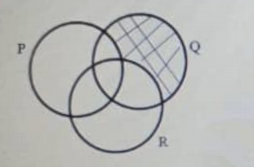
In the Venn diagram above, the shaded region is
Attached Figure / Diagram
A
(P \(\cap\) Q)' \(\cap\) R
B
(P \(\cap\) Q) \(\cup\) R)
C
(P \(\cup\) Q) \(\cap\) R
D
(P U R)' \(\cap\) Q
medium Difficulty
Verified Correct Answer: Option D
Step-by-Step Mathematical Solution
The Venn diagram has three overlapping circles labeled P, Q, and R.
The shaded region has cross-hatching and covers only the part that belongs to Q but not to P or R (the exclusive part of Q outside the overlaps with P and R).
In set notation, the shaded region is \( Q \cap (P \cup R)^c \)
Source: WAEC / JAMB / NECO Classroom Archive (Record #74198)