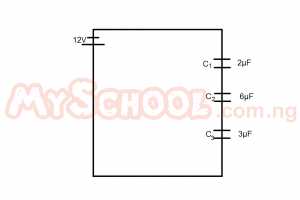
The diagram above shows the capacitors C\(_1\), C\(_2\) and C\(_3\) 2\muF, 6\muF and 3\muF respectively. The potential difference across C\(_1\), C\(_2\) and C\(_3\) respectively are
Attached Figure / Diagram
A
4V, 6V and 2V
B
2V, 6V and 4V
C
6V, 4V and 2V
D
6V, 2V and 4V
Verified Correct Answer: D.
Physical Principles & Numerical Solution
C = \(\frac{\text{Q}}{\text{V}}\) => Q = CV : ∴ V = \(\frac{\text{Q}}{\text{C}}\)
∴V\(_1\) = \(\frac{\text{Q}}{C_1}\); V\(_2\) = \(\frac{\text{Q}}{C_2}\);
V\(_3\) = \(\frac{\text{Q}}{C_3}\)
for series
\(\frac{1}{\text{C}}\) = \(\frac{1}{C_1}\) + \(\frac{1}{C_2}\) + \(\frac{1}{C_3}\)
= \(\frac{1}{2} + \frac{1}{6} + \frac{1}{3}\)
= \(\frac{3 +1 + 2}{6}\)
= \(\frac{6}{6}\) = 1
∴ C = 1\muF = 1.0 x 10\(^{-6}\)F
∴ Q = CV = 1.0 x 10\(^{-6}\) x 12
= 12.0 x 10\(^{-6}\)C
∴V\(_1\) = \(\frac{\text{Q}}{C_1}\)
= \(\frac{12 \times 10^{-6}}{2 \times 10^{-6}}\)
= 6V
V\(_2\) = \(\frac{\text{Q}}{C_2}\)
= \(\frac{12 \times 10^{-6}}{6 \times 10^{-6}}\)
= 2V
V\(_3\) = \(\frac{\text{Q}}{C_3}\)
= \(\frac{12 \times 10^{-6}}{3 \times 10^{-6}}\)
= 4V
∴ 6V, 2V and 4V
Source: Myschool Past Questions Archive (Record #11841)