You are provided with two resistance wires labeled A and B, a1\(\Omega\) standard resistor Rx, and other necessary apparatus.
Connect \(R_x\) in the left-hand gap of the metre bridge, a length L= 100cm of wire A in the right-hand gap, and the other apparatus as shown in the diagram above.
Determine and record the balance point P on the bridge wire NQ.
Measure and record \(l_x\) = NP and \(l_y\) = PQ.
Evaluate \(R_1\) = \(\frac{I_{y}}{L_{x}}\) = \(R_x\)
Repeat the procedure for four other values of L= 95, 85, 75 and 65cm. In each case, determine and record the balance point P and the length \(l_x\) and \(l_y\). Also, evaluate \(R_1\).
Repeat the experiment with the second wire B. Obtain the balance points P and the values of and \(l_x\) and \(l_y\).
Evaluate \(R_1\) = \(\frac{I_{y}}{L_{x}}\) = \(R_x\) in each case. Tabulate your readings.
Plot a graph of \(R_2\) on the vertical axis against \(R_1\) on the horizontal axis.
Determine the slope, s, of the graph.
Evaluate k = \(\sqrt s \).
State two precautions taken to obtain accurate results.
(b)i. State two advantages of using a potentiometer over a voltmeter for measuring the potential difference.
ii. Define the internal resistance of a cell.
Attached Figure / Diagram
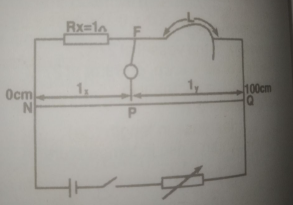
Verified Correct Answer: .
Physical Principles & Numerical Solution
L(cm)
Lx(cm)
Ly(cm)
\(R_1\)=Ly. L x R
L\(x_1\)
L\(y_1\)
\(R_2\),(Ly/Lx)Rx
100
5.2
95.0
18.3
21.5
78.3
3.64
95
6.0
94.0
15.7
22.6
77.8
3.44
85
6.5
94.0
14.5
22.8
76.4
3.35
75
7.8
93.1
12.0
23.4
75.6
3.23
65
8.5
95.5
11.2
24.3
75.2
3.10
k = s
s = 0.0903
k = 0.0903 = 0.3005
Precautions: I
ensured keys were removed when not taking readings.
ensured tight connections/clean terminals.
avoided parallax errors in reading meter rule.
ensured jockey did not scratch the resistance wire.
avoided zero error of meter rule noted and corrected.
(b)i. Advantages of the potentiometer over the voltmeter
- High accuracy
- Null deflection (does not draw current at balance point).
- Range can be increased as required.
- No friction in moving parts.
ii. The internal resistance of a cell is the opposition to the current flow through (the electrolyte of) the cell.
Source: Myschool Past Questions Archive (Record #60036)