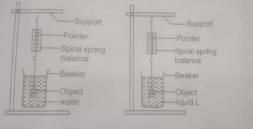
Study the diagrams above and use them as guides in carrying out the following instructions.
Using the spring balance provided, determine the weight of the object of mass M= 50.0g in air. Record this weight as \(W_1\).
Determine the weight of the object when it is completely immersed in water contained in a beaker as shown in the diagram above. Record the weight as \(W_2\).
Determine the weight of the object when it is completely immersed in a liquid labeled L. Record the weight as \(W_3\).
Evaluate U = (\(W_1\) - \(W_2\)) and V = (\(W_1\) -\(W_3\)).
Repeat the procedure with the objects of masses M= 100g, 150g, 200g, and 250g
In each case, evaluate U = (\(W_1\) - \(W_2\)) and V = (\(W_1\) -\(W_3\)).
Tabulate your readings.
Plot a graph with V on the vertical axis and U on the horizontal axis.
Determine the slope, s, of the horizontal graph.
State two precautions taken to ensure accurate results.
(b)i. State Archimedes' principle.
ii. A piece of brass of mass 20.0g is hung on a spring balance from a rigid support and completely immersed in kerosene from of density 8.0 x 10\(^{2}\)kgm\(^{-3}\). Determine the readings of the spring balance (g= 10ms\(^{-2}\), density of brass 8.0 x 10\(^{3}\)kgm\(^{-3}\))
Attached Figure / Diagram
Verified Correct Answer: .
Physical Principles & Numerical Solution
M\(_{(g)}\)
\(W_1\)
\(W_2\)
\(W_3\)
U=(\(W_1\)-\(W_2\))
V=(\(W_1\)-\(W_3\))
50
0.50
0.43
0.45
0.07
0.05
100
1.00
0.90
0.88
0.10
0.17
150
1.50
1.30
1.33
0.20
0.17
200
2.00
1.73
1.75
0.27
0.25
250
2.50
2.15
2.20
0.35
0.30
SEE THE GRAPH ABOVE
Slope, s = \(\frac{y_{2}-y_{1}}{x_{2}-x_{1}} = \frac{0.275-0.10}{0.32-0.125}\)
s = \(\frac{0.175}{0.195}\) = 0.9
Precautions: i
- ensured that I avoided errors due to parallax while taking the readings on the spring balance.
- made sure the mass is totally immersed in water and liquid
- ensured the retort stand and clamp are well tightened.
(b)i. Archimedes' principle states that when a body is totally immersed in a fluid (liquid or gas), it experiences an upthrust that is equal to the weight of the fluid displaced.
Mass of brass = 20g = 2 x 10\(^{-2}\)kg
Density of kerosine 8.0 x 10\(^{2}\)kgm\(^{-3}\)
g = 10ms\(^{-2}\)kg
Density of brass = 8.0 x 10\(^{3}\)kgm\(^{-3}\)kg
Volume of brass = \(\frac{m}{D} = \frac{2 \times 10}{8 \times 10^{3}}\) = \(\frac{2}{8}\) x 10\(^{-2-3}\)
= 0.25 x 10\(^{-5}\)m\(^{3}\)
Volume of brass = 2.5 x 10\(^{-6}\)m\(^{3}\)
Therefore, the mass of brass in kerosene
m = Density x volume of brass
= 8.0 x 10\(^{2}\) x 2.5 x 10\(^{-6}\)m\(^{3}\)
= 20 x 10\(^{-4}\)
Reading on the spring balance
20 x 10\(^{-4}\) = 20 x 10\(^{-3}\) N
Source: Myschool Past Questions Archive (Record #59997)