A Uniform beam PQ of mass 20kg and length 5m is balanced as shown above, a man of weight 800N stands at M such that QM = 2m. The reaction at P and Q respectively are(take g = 10ms-2)
Attached Figure / Diagram
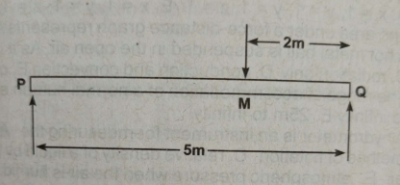
A
300N and 500N
B
420N and 580N
C
220N and 380N
D
580N and 420N
E
382N and 220N
Verified Correct Answer: B.
Physical Principles & Numerical Solution
The downward forces acting on the system are the weight of the man (800 N) and the weight of the beam (200 N). Thus, the total downward force is:
\(800 \, \text{N} + 200 \, \text{N} = 1000 \, \text{N}\)
The total upward forces are represented by reactions \( P \) and \( Q \):
\(P + Q = 1000 \, \text{N}\)
Since the beam is uniform, its weight acts at the center, which is located 2.5 m from either end.
To satisfy the condition of equilibrium, the total clockwise moments must equal the total anticlockwise moments. Taking moments about point \( Q \):
\((200 \, \text{N} \times 2.5 \, \text{m}) + (800 \, \text{N} \times 2 \, \text{m}) = P \times 5 \, \text{m}\)
Calculating the moments:
\(500 \, \text{N}\cdot\text{m} + 1600 \, \text{N}\cdot\text{m} = 5P\)
This simplifies to:
\(2100 \, \text{N}\cdot\text{m} = 5P\)
Solving for \( P \):
\(P = \frac{2100}{5} = 420 \, \text{N}\)
Now, substituting \( P \) back into the upward force equation:
\(420 \, \text{N} + Q = 1000 \, \text{N}\)
Solving for \( Q \):
\(Q = 1000 - 420 = 580 \, \text{N}\)
Thus, the reactions at \( P \) and \( Q \) are: 420N and 580N respectively.
Source: Myschool Past Questions Archive (Record #41626)